


Choose an Oval Diamond Ring That Flatters Your Hand
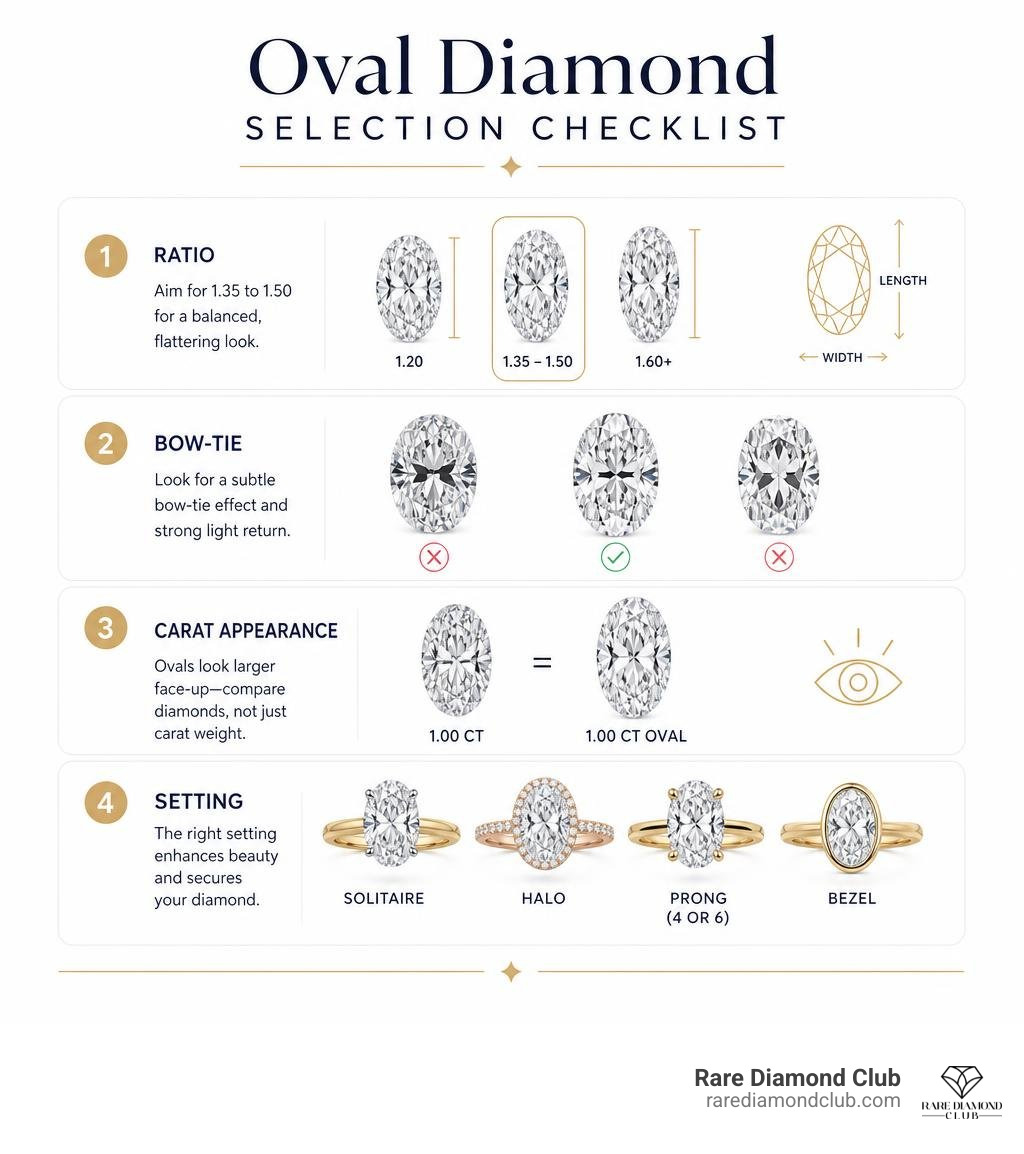
Oval Diamond Rings are an excellent choice if you want a diamond that looks larger face-up, adds a longer look to the finger, and still delivers bright, brilliant sparkle. For a balanced, timeless look, start with an oval length-to-width ratio around 1.35 to 1.50, then compare diamonds in person or by clear video to check for even light return and a subtle bow-tie shadow.
Oval diamonds blend the fire of a brilliant-cut stone with a softer, elongated outline. They are also often priced 10-20% below round brilliant diamonds of similar carat weight and quality, making them a strong option for buyers focused on visual size and value.
The setting matters just as much. A simple solitaire puts the oval center stone first, while a halo can add more visual presence. Four- or six-prong settings offer a classic look, and a bezel gives a clean, modern frame.
At Rare Diamond Club, you can explore diamond-only engagement ring designs with both natural and lab-grown diamonds, including custom options built around the oval shape, your preferred proportions, and your ideal setting style.
Why Oval Diamond Rings Are a Leading Engagement Ring Choice

The oval diamond has quickly established itself as a premier silhouette in fine bridal jewelry. Over the past five years leading into 2026, oval-cut diamonds have experienced a remarkable 30% surge in popularity for engagement rings. Today, the oval cut stands firmly as the second most sought-after fancy diamond shape, capturing roughly 15% of all fancy-cut diamond sales worldwide. Google Trends reflects this shift as well, showing that search interest for the oval diamond engagement ring has surged by over 40% since 2018.
What drives this enduring appeal? The secret lies in the optical magic of the modified brilliant cut combined with an elongated silhouette:
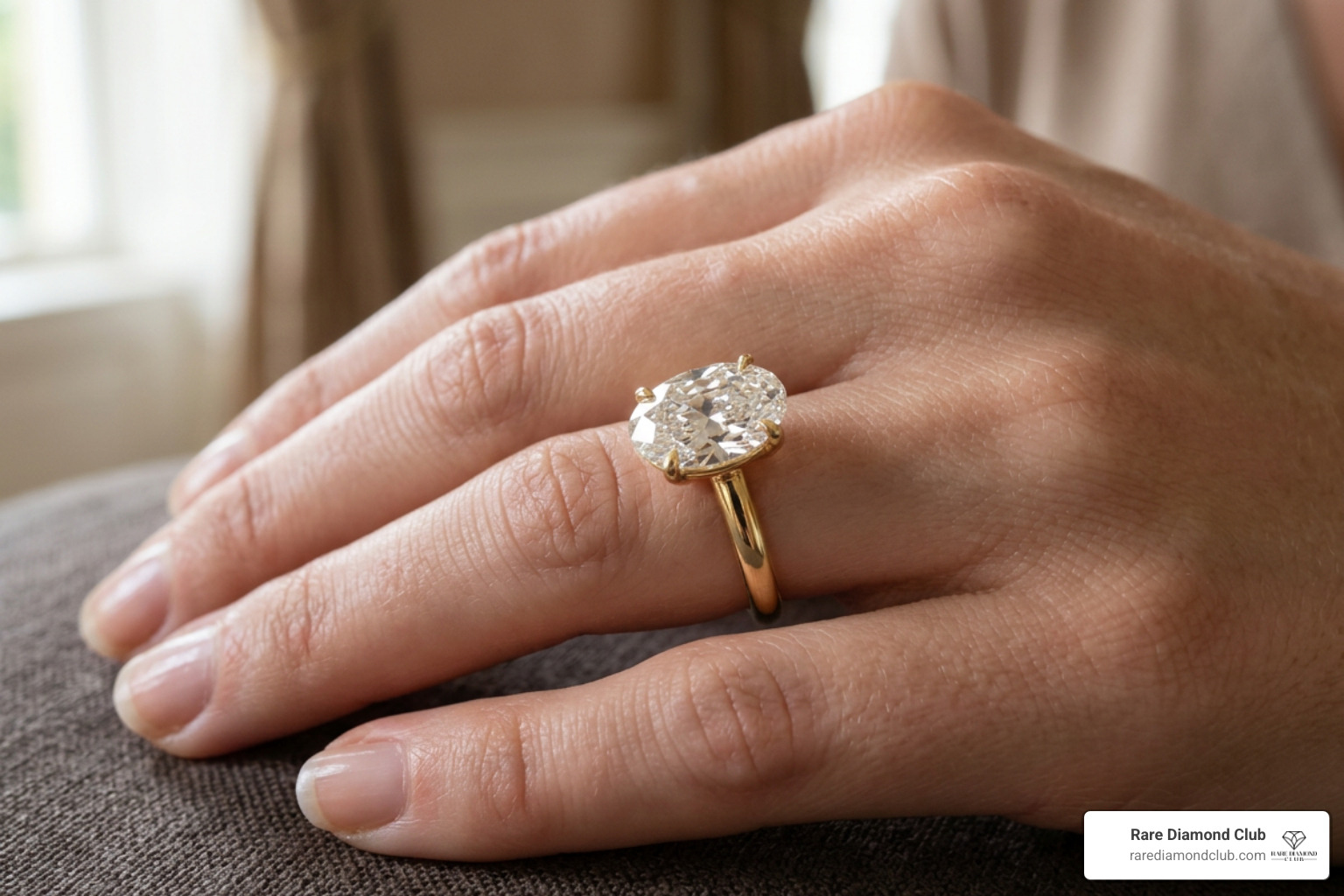
- The Finger-Lengthening Effect: An oval diamond’s vertical orientation creates an immediate slimming, elongating line along the finger. This flattering proportion looks balanced and graceful on hands of any size.
- Superior Surface Area (Face-Up Spread): Because oval diamonds are cut with shallower depths and longer dimensions, they present a significantly larger surface area than classic round cuts of identical carat weight. You get a diamond that visibly dominates the hand without requiring a jump in carat size.
- Continuous Fire and Scintillation: Retaining 57 to 58 facets—similar to a standard round brilliant—the oval cut reflects light with dazzling brilliance, masking minor inclusions while delivering high sparkle.
| Diamond Shape | Typical Carat Weight | Visual Face-Up Surface Area (mm²) | Perceived Visual Size |
|---|---|---|---|
| Round Brilliant | 1.00 ct | ~33.2 mm² | Baseline standard |
| Oval Cut | 1.00 ct | ~36.5 mm² | ~10% larger visual spread |
| Round Brilliant | 2.00 ct | ~51.5 mm² | Baseline standard |
| Oval Cut | 2.00 ct | ~56.8 mm² | ~10–12% larger visual spread |
This geometric advantage allows couples to maximize their visual presence on the hand while enjoying a romantic, curved silhouette that bridges modern elegance and vintage charm.
Critical Factors to Evaluate in an Oval Cut Diamond
Unlike round diamonds, fancy shapes like ovals do not receive an official standardized cut grade (such as Excellent or Ideal) on laboratory grading reports from institutions like the Gemological Institute of America (GIA). As a result, selecting an exceptional oval diamond requires understanding its specific anatomy, facet alignment, and color retention.
When assessing an oval center stone, keep these essential technical criteria in mind:
- Symmetry and Outline: Look for smooth, gently rounded curves. The shoulders should be even and rounded rather than boxy (flat-sided) or overly pointed like an elongated football.
- Color Concentration: Elongated fancy shapes tend to concentrate body color near their curved tips. If you prefer an icy-white presentation, we recommend selecting an F, G, or H color grade in natural or lab-grown diamonds.
- Clarity Distribution: The brilliant faceting pattern of an oval diamond hides minor internal inclusions exceptionally well. An eye-clean VS1, VS2, or well-placed SI1 clarity grade often delivers pristine beauty without the premium price of flawless clarity grades.
At Rare Diamond Club, we specialize exclusively in fine diamond jewelry, providing hand-selected natural and lab-grown diamonds that meet strict standards for symmetry, polish, and light performance.
Understanding Dimensions and Proportions in Oval Diamond Rings
An oval’s personality is largely dictated by its length-to-width ratio (L:W). This ratio is calculated by dividing the diamond's length in millimeters by its width.
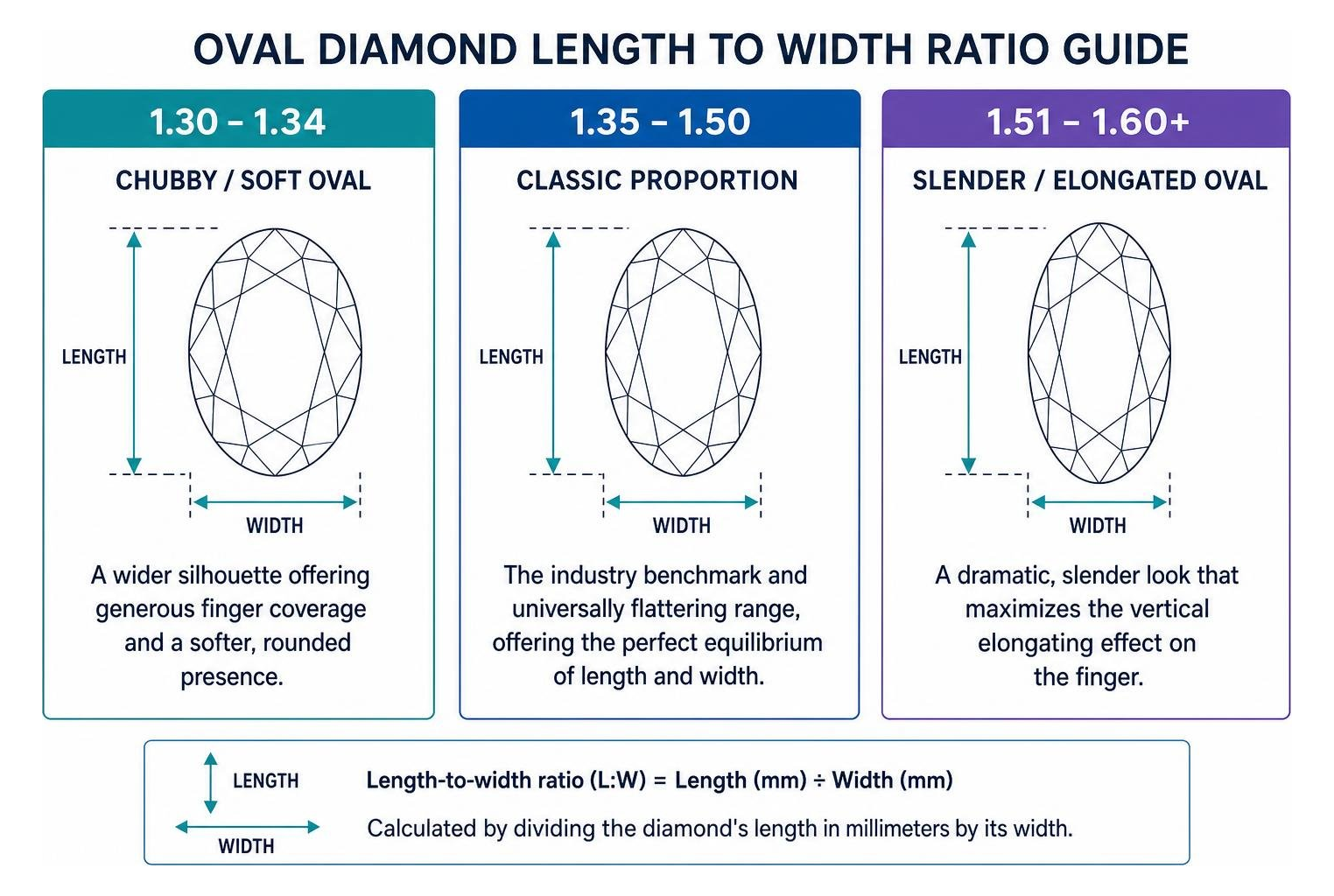
- 1.30 to 1.34 (Chubby / Soft Oval): A wider silhouette offering generous finger coverage and a softer, rounded presence.
- 1.35 to 1.50 (Classic Proportion): The industry benchmark and universally flattering range, offering the perfect equilibrium of length and width.
- 1.51 to 1.60+ (Slender / Elongated Oval): A dramatic, slender look that maximizes the vertical elongating effect on the finger.
For those who love a perfectly balanced profile held securely in a classic design, the 1.5cttw Oval Shaped Lab Grown Diamond Plain Cathedral Trellis Shank Solitaire Engagement Ring in 14k Gold highlights the stone's natural symmetry while elevating the diamond to capture maximum light.
Evaluating Brilliance and Managing the Bow-Tie Effect
Because of the oval diamond's elongated facet layout, nearly all oval cuts produce a darkened optical shadow across their center known as the bow-tie effect. This phenomenon occurs when light entering the center of the diamond casts a shadow rather than bouncing back up to your eye.
A subtle bow tie is completely natural and adds dynamic contrast and depth to the stone's movement. However, a severe, dark bow tie indicates light leakage that dulls the center of the stone.
When evaluating an oval cut:
- Examine the diamond in multiple lighting conditions.
- Confirm that the center facets reflect bright, crisp flashes rather than a fixed, opaque black bar.
- Ensure the facet junctions align smoothly across the midsection of the stone.
Most Flattering Setting Styles for Oval Engagement Rings
Setting an oval diamond requires balancing aesthetic beauty with physical protection. Because oval stones have no sharp corners (unlike princess or marquise cuts), they are inherently resistant to chipping. However, their elongated shape benefits from strategic prong placement and secure structures.
Nearly 70% of oval diamond rings are set in either a solitaire or halo setting, reflecting a desire for both classic purity and amplified sparkle.
Solitaire Variations and Contemporary Band Profiles
A solitaire setting remains the purest way to showcase the distinct curves of an oval center stone. Whether mounted on a delicate rounded band or a dramatic knife-edge band, solitaires keep all focus on the diamond.
- Classic Four-Prong vs. Six-Prong: Four prongs leave more of the diamond visible, while six prongs offer enhanced security and emphasize the oval's curved geometry.
- Knife-Edge Bands: A knife-edge shank features a subtle central ridge that catches light along the metal, drawing the eye straight to the center diamond.
If you appreciate traditional sophistication, the Natural Diamond Oval Solitaire Engagement Ring and the Lab Grown Oval Solitaire Engagement Ring provide minimalist settings crafted in premium metals. For a sharper, contemporary profile, consider the 2cttw Oval Shaped Lab Grown Diamond Knife Edge Shank Solitaire Engagement Ring in 14k Gold.
Hidden Halo and Vintage Inspired Accents
If you love subtle details, modern halo variations offer brilliance without overwhelming the center stone's silhouette.
- Hidden Halos: A collar of micro-pavé diamonds wraps around the base of the basket beneath the center diamond. It leaves the top view completely clean while offering a shimmering secret from the profile.
- Vintage Halos & Milgrain: Traditional halos surround the perimeter with accent stones and intricate beaded milgrain edges, channeling vintage romance.
Explore these captivating variations through our Lab Grown Hidden Halo Oval Engagement Ring, the Natural Diamond Hidden Halo Oval Engagement Ring, or the ornate Lab Grown Vintage Inspired Oval Halo Engagement Ring.
Price Comparison: Oval Cuts Versus Other Diamond Shapes
When budgeting for an engagement ring, diamond shape plays a major role in overall cost. Oval diamond rings typically cost 10% to 20% less than round brilliant diamonds of matching carat weight, color, and clarity.
This cost efficiency is due to cutting yields from rough diamond crystals:
- Round brilliant cuts lose substantial raw material during the cutting process (often over 50% of the rough stone).
- Oval diamonds conform more naturally to the elongated crystal structure of rough diamonds, reducing waste during cutting and lowering the finished stone's price-per-carat.
Pricing advantages of choosing an oval cut include:
- Lower cost per carat compared to round brilliant cuts.
- Greater face-up visual size per dollar spent.
- Exceptional flexibility to invest savings into higher metal purities like platinum or customized ring settings.
If you are looking to design a bespoke engagement ring tailored to your specific budget and style preferences, we create custom pieces through our atelier for Custom Engagement Rings in New York City. You can also explore our curated bridal showroom collections for Diamond Engagement Rings in NYC.
Maximizing Carat Weight and Value with Oval Diamond Rings
Because oval cuts look larger face-up and cost less per carat, they are the ideal silhouette for achieving a bold, high-carat look. Choosing an oval cut allows you to reach prominent 2-carat or 3-carat milestones within comfortable budgets.
For instance, the 3cttw Oval Shaped Lab Grown Diamond Classic Solitaire Ring in 14k Gold offers stunning visual presence, combining a large, brilliant face-up area with a classic solitaire mounting.
Frequently Asked Questions About Oval Engagement Rings
What is the most popular length-to-width ratio for an oval diamond?
The most sought-after length-to-width ratio for an oval diamond ranges between 1.35 and 1.50. This proportion provides a classic oval outline that balances finger-slimming elongation with a full, curved silhouette. Ratios below 1.30 create a wider, rounder oval, while ratios above 1.50 produce an ultra-slender look.
Do all oval diamonds exhibit a noticeable bow-tie effect?
Yes, virtually all oval-cut diamonds feature some degree of a bow tie due to how light reflects through an elongated brilliant facet pattern. However, a well-cut diamond will have a soft, subtle bow tie that blends naturally with the diamond's overall fire and scintillation, rather than a heavy, dark shadow across the center.
How do natural and lab-grown oval diamonds compare in pricing?
Both natural and lab-grown oval diamonds share identical physical, chemical, and optical characteristics. However, lab-grown diamonds generally cost 60% to 80% less than natural diamonds of equivalent carat, color, and clarity. This allows you to choose either the timeless heritage of an earth-mined stone or the accessible scale of a lab-grown diamond based on your personal priorities.
Conclusion
Choosing an oval diamond ring gives you the best of both worlds: timeless fire, flattering finger elongation, and outstanding visual spread for your investment. Whether you prefer a clean, minimalist solitaire, a sparkling hidden halo, or an ornate vintage-inspired setting, the oval diamond is a versatile centerpiece for your engagement ring.
At Rare Diamond Club, our focus is strictly on diamond jewelry, offering an exclusive selection of bridal rings crafted with made-to-order precision. We are proud to provide both natural and lab-grown diamonds across all our designs, ensuring that every couple discovers a diamond ring that aligns with their personal values and aesthetic taste.
Ready to begin your journey? Explore our full collection of bridal settings or collaborate with our master jewelers at Rare Diamond Club to curate your dream diamond engagement ring today.