


Why an Art Deco Platinum Diamond Ring Still Stands Apart
An art deco platinum diamond ring is a vintage or vintage-inspired ring known for its bold geometry, fine hand detail, and durable platinum setting. Authentic examples usually date from the 1920s and 1930s, pairing antique diamond cuts with details such as milgrain edges, pierced filigree, engraving, and vivid sapphire or emerald accents.
For a quick way to recognize one, look for:
- Era: Most original Art Deco rings were made between the 1920s and 1930s.
- Metal: Platinum was prized for its strength and its ability to hold delicate, openwork designs.
- Style: Symmetry, straight lines, step patterns, and architectural shapes define the look.
- Diamonds: Old European, Old Mine, transitional, and Asscher cuts are common period choices.
- Craftsmanship: Hand engraving, tiny beaded milgrain borders, and airy filigree add character that modern mass-made rings rarely match.
These rings feel both historic and strikingly modern. A large old-cut diamond in a milgrain bezel, for example, can sit beside precise geometric accents and engraved platinum work - a combination that captures the optimism and design confidence of the Roaring Twenties.
For collectors and couples alike, the appeal goes beyond appearance. An original ring carries its own story, while a carefully made Art Deco-inspired design offers the same visual language with modern fit, wearability, and diamond options.
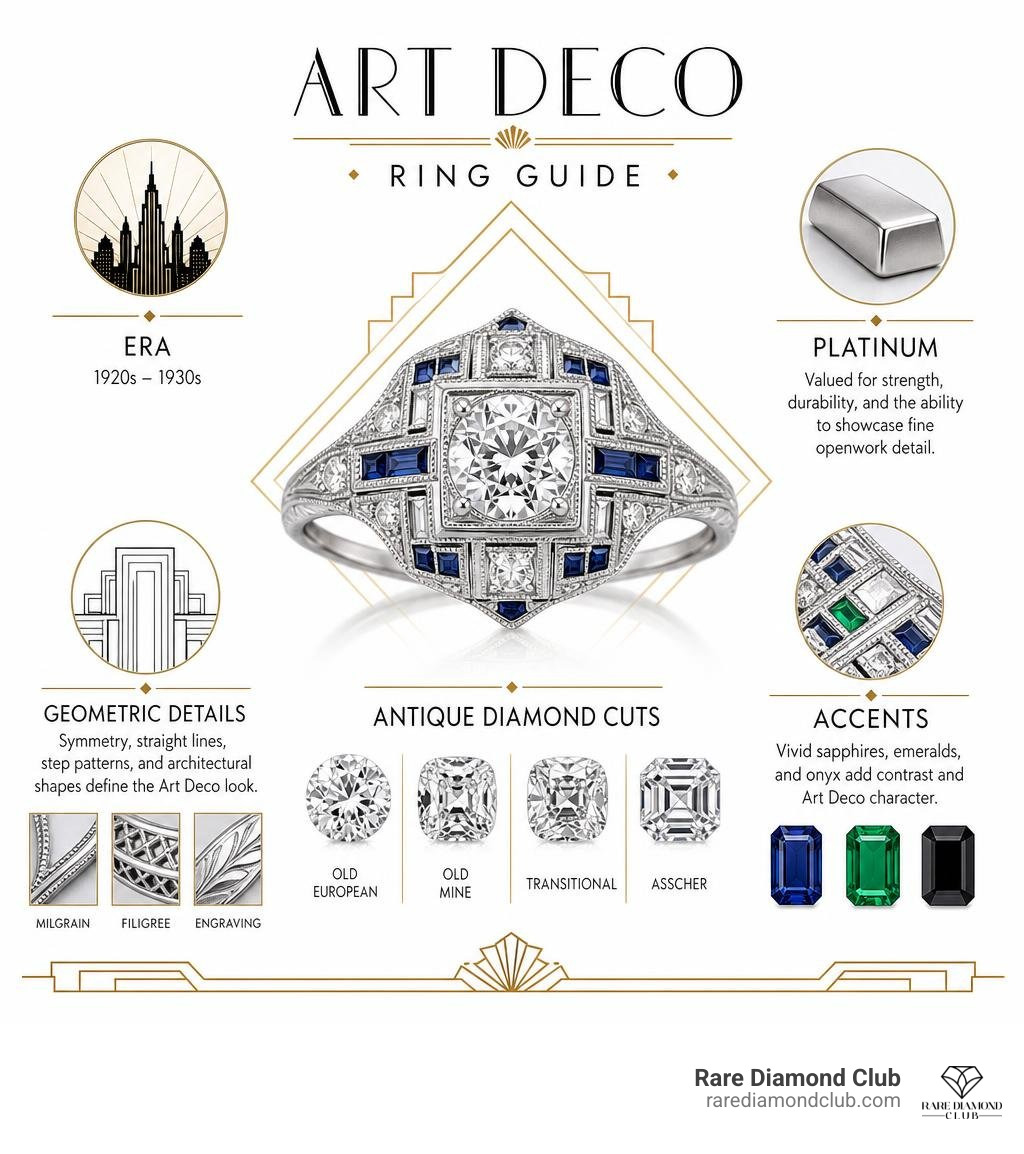
Defining Characteristics of an Art Deco Platinum Diamond Ring
The Art Deco movement took center stage in the 1920s and 1930s, reflecting a dramatic shift from softer, organic themes toward crisp geometry, urban architecture, and industrial innovation. When master jewelers of the Jazz Age embraced platinum, it transformed fine jewelry forever.
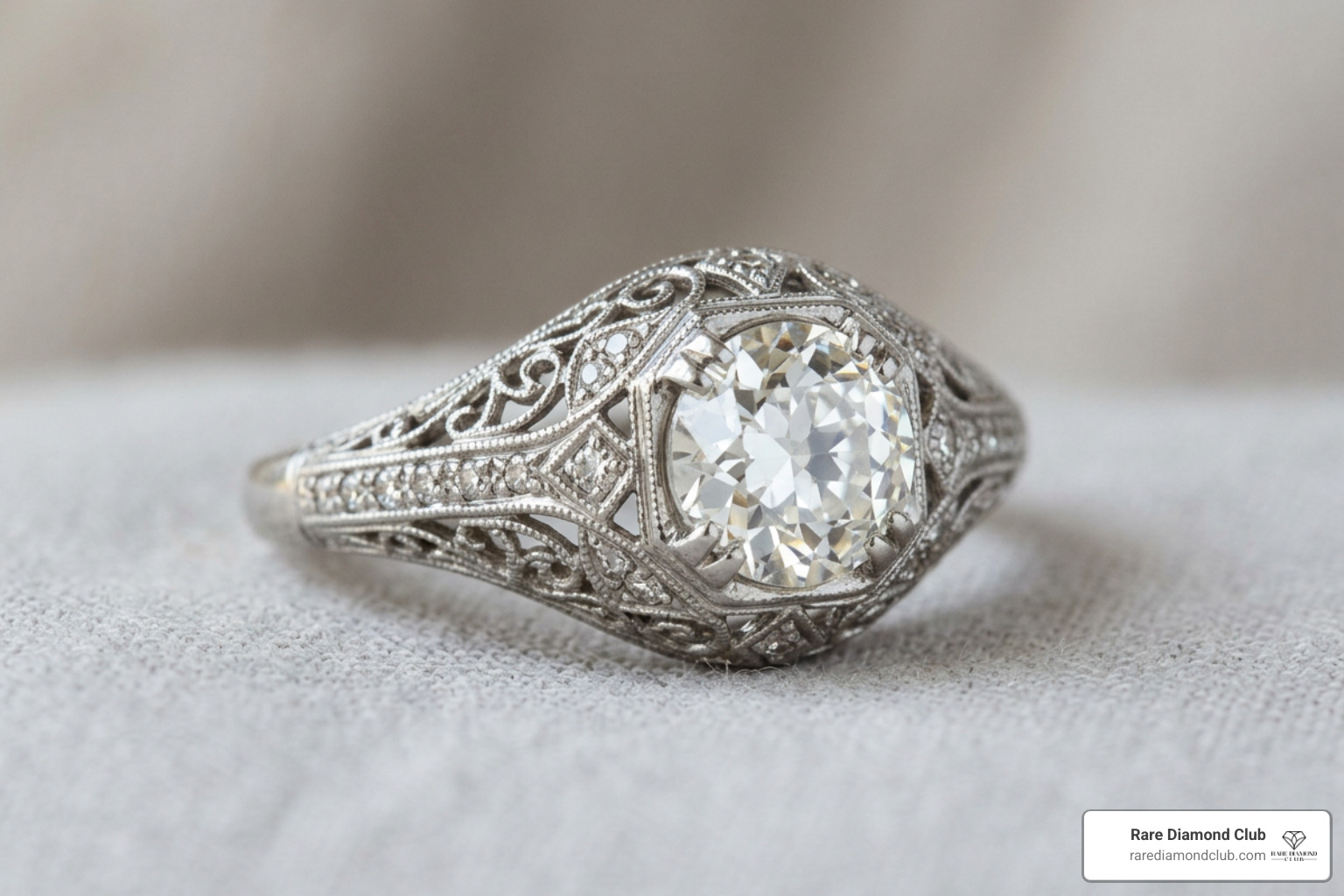
Unlike gold, platinum possessed unprecedented strength and density. Jewelers realized they could pull the metal into incredibly fine wires and construct intricate lattice patterns without risking structural failure. An authentic art deco platinum diamond ring balances delicate visual appeal with robust, lasting construction.
The shift toward geometric symmetry meant rings featured octagonal borders, crisp rectangular profiles, repeating chevron shapes, and starburst settings. Rather than letting a single diamond sit alone on a simple wire shank, Art Deco jewelers treated the entire top surface of the ring as an architectural canvas.
Decorative Details: Milgrain, Filigree, and Engravings
When you closely inspect an antique platinum ring from this era, the sheer level of miniature handwork is staggering. Three main decorative techniques define the period:
- Milgrain Edging: Derived from the French mille-grain (meaning "a thousand grains"), milgrain consists of tiny, beaded metal ridges pushed into the edges of bezels and borders using a small hand wheel. It frames diamonds like miniature picture frames and gives the surface a subtle texture that catches light.
- Pierced Filigree: Jewelers hand-punched, drilled, and sawed tiny geometric openings into thin sheets of platinum. This airy openwork allowed light to flood the diamonds from beneath while keeping the overall piece lightweight and comfortable.
- Hand Engraving: Wheat motifs, laurel leaves, and flowing scroll engravings were commonly hand-carved onto the sides of the platinum band and under-gallery. For example, a classic circa 1930s ring might feature a center diamond held securely in a milgrain bezel, completely wrapped in hand-engraved wheat and scroll motifs.
Accent Gemstones: Sapphires, Emeralds, and Side Stones
While diamonds were the undisputed stars of the era, Art Deco designers loved high-contrast color combinations. Deep blue cobalt sapphires, rich green emeralds, and jet-black onyx were custom-cut into calibré styles—tiny rectangular or triangular gemstones fitted seamlessly side-by-side along geometric borders.
Accent diamonds also played a key supporting role. Jewelers frequently utilized antique rose-cut diamonds (featuring flat bottoms and faceted dome tops) or small single-cut diamonds along the shoulders of the ring to create continuous glitter around the focal stone.
Diamond Cut Evolution: Antique vs. Modern Styles
Understanding diamond cuts from the 1920s and 1930s requires stepping back to a time before computerized laser cutting existed. Diamonds were faceted by hand under hand-lenses, shaped to maximize weight retention and sparkle under candlelight and soft tungsten bulbs rather than harsh modern fluorescent lighting.
| Cut Type | Era Popularity | Facet Arrangement | Light Performance & Character |
|---|---|---|---|
| Old Mine Cut | 18th Century – Early 1900s | Cushion shape, high crown, small table, large culet | Warm, romantic dispersion with broad flashes of color |
| Old European Cut | Late 1800s – 1930s | Round outline, high crown, small table, open culet | Deep inner fire, distinct floral pattern in the center |
| Transitional Cut | 1920s – 1940s | Lower crown, larger table, smaller culet than Old European | Bridge between antique warmth and modern brilliant symmetry |
| Asscher Cut | Patented 1902 (Deco peak) | Octagonal/square step cut, cropped corners | "Hall-of-mirrors" clarity and sharp geometric depth |
| Modern Round Brilliant | Mid-20th Century – Present | Precise 57-58 facets, thin girdle, no open culet | Maximum white light return and intense high-frequency scintillation |
Antique Cuts in an Art Deco Platinum Diamond Ring
If you inspect an authentic art deco platinum diamond ring, you will rarely find a modern round brilliant diamond unless it was replaced during a later restoration. Instead, you will encounter captivating historical cuts:
- Old Mine Cut: Recognizable by its slightly soft, cushion-like square outline, high crown, and noticeable open culet at the bottom peak. A massive 4.00-carat Old Mine cut diamond set into a 1930s platinum milgrain bezel represents the height of vintage luxury.
- Old European Cut: The immediate predecessor to the modern round cut. These stones feature a perfectly round perimeter, a small top table facet, and long triangular pavilion facets that produce dramatic "chunky" flashes of spectral color. You might see a certified 2.06-carat J/VS1 or a 1.68-carat L/VS2 Old European cut diamond serving as the heart of a breathtaking 1920s engagement ring.
- Transitional Brilliant Cut: Developed during the Art Deco era as diamond cutters refined their mathematical formulas. These stones kept the soulful warmth of older cuts while introducing lower crowns and larger tables.
- Asscher Cut: Invented by the Asscher brothers in 1902, this octagonal step-cut became an icon of 1920s geometry. Its concentric step facets draw the eye deep into the center of the diamond like a hall of mirrors.
Comparing Art Deco, Edwardian, and Victorian Rings
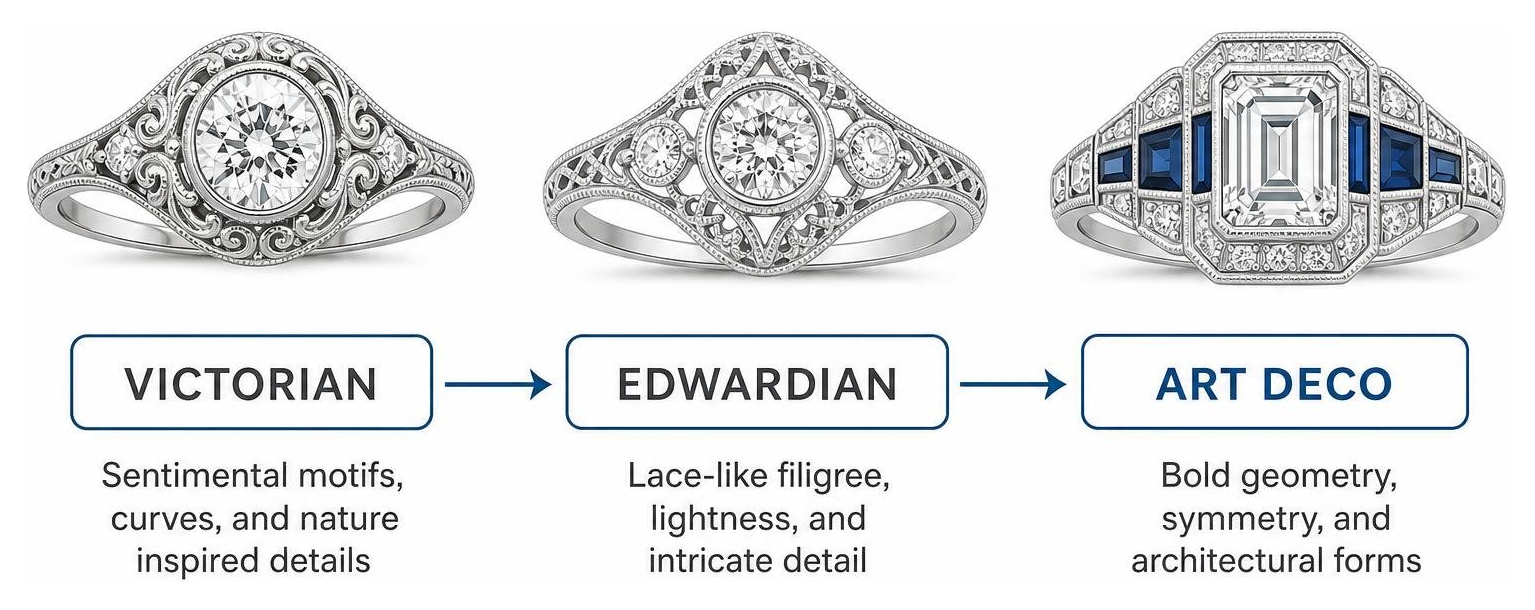
It is easy to mix up historical eras, but comparing their dominant metals, design themes, and overall aesthetics makes the differences clear:
- Victorian Era (1837–1901): Romantic, sentimental, and nature-inspired. Yellow gold, rose gold, and silver-topped gold were standard. Designs favored snakes, crescents, hearts, and cluster settings.
- Edwardian Era (1901–1915): Delicate, ethereal, and garland-inspired. Jewelers began working with platinum to recreate lace, ribbons, bowknots, and delicate tiara motifs. The overall mood was light, soft, and feminine.
- Art Deco Era (1920–1939): Architectural, bold, and unapologetically modern. Soft curves gave way to hexagons, sunbursts, step-cut diamonds, contrasting sapphire borders, and structural symmetry.
Authenticating, Valuing, and Purchasing at Auction
Navigating the market for authentic antique jewelry requires a careful eye. Because authentic pieces are finite, their value continues to appreciate, making them prized possessions for both couples and serious collectors.
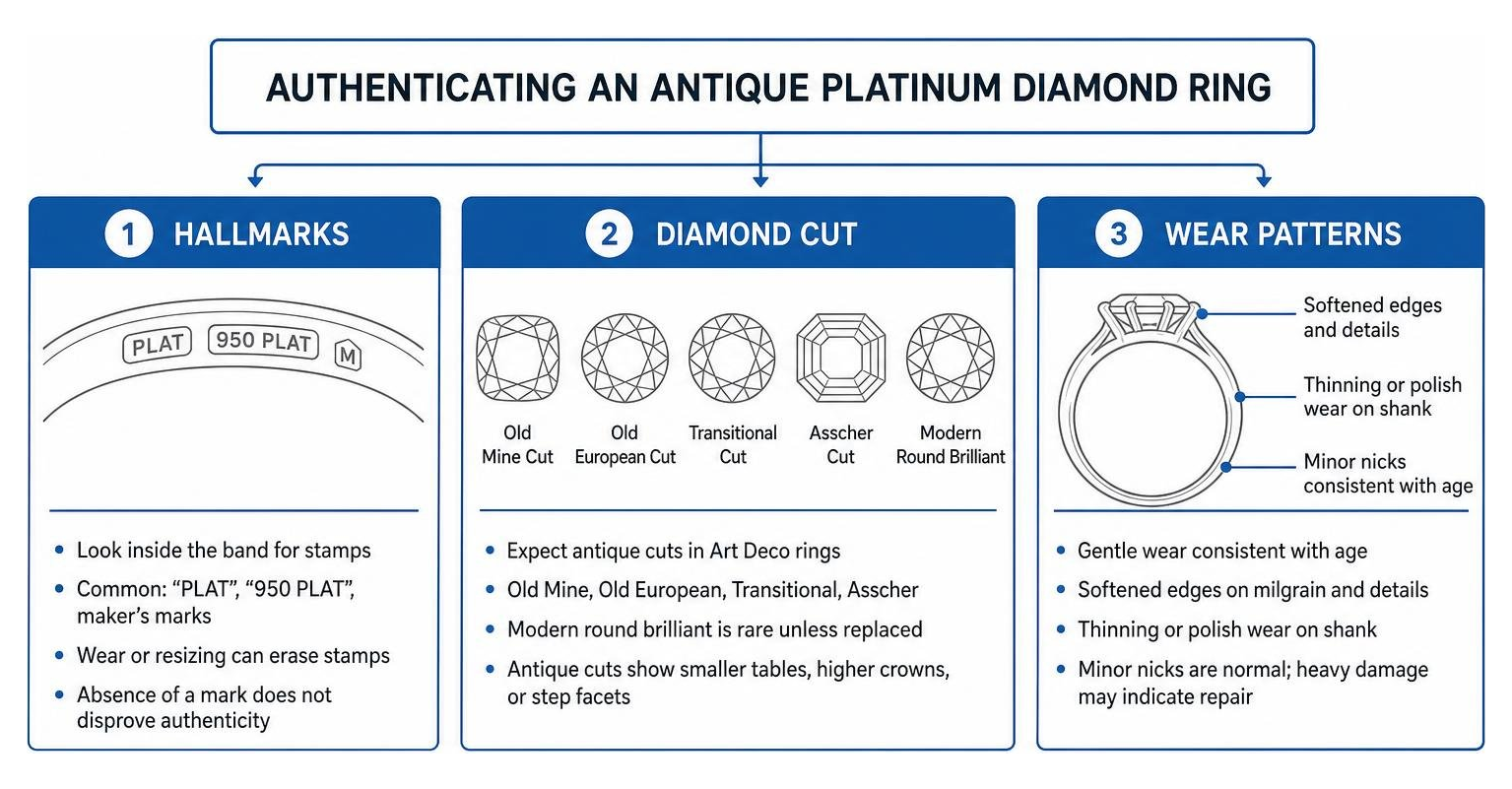
When hunting for a true 1920s piece, checking hallmark stamps inside the band is essential. Look for stamps such as "PLAT," "950 PLAT," or historical maker’s marks. However, resizing over a century can sometimes erase internal stamps, so hallmark absence alone does not disprove authenticity.
For those exploring fine estate pieces, reviewing verified secondary market listings—like this Art Deco Filigree Platinum Engagement Ring With Diamonds Auction—provides real-world insights into bidding trends, condition reports, and era-specific detailing.
Evaluating the Value of Your Art Deco Platinum Diamond Ring
Several core variables influence what a fine vintage platinum ring is worth:
- Center Diamond Quality & Rarity: Carat weight, color, and clarity remain primary value drivers. A ring featuring a 2.00+ carat GIA-certified Old European cut with G to J color and VS clarity commands a strong premium over smaller accent-driven rings.
- Metal Mass & Condition: Intricate filigree that remains crisp and uncracked adds significant value. Platinum pieces that retain their original weight (often 3.0 grams or more for delicate bands, and heavier for cocktail styles) hold value exceptionally well.
- Originality: Rings that retain their original center stone rather than a modern replacement diamond are substantially more desirable to collectors.
- Auction Estimates vs. Retail: Entry-level vintage platinum filigree rings with modest center diamonds (around 0.30 to 0.50 carats) often show auction estimates ranging from $1,000 to $1,500, while larger 2.00 to 4.00-carat museum-quality centerpieces regularly reach tens of thousands.
To stay updated on changing market values, diamond trends, and historical design guides, browse our latest analysis on our Blogs News page.
Smart Bidding: Appraisals, Certification, and Sizing
If you plan to bid on an antique piece at auction or buy online, keep these practical tips in mind:
- Request Independent Certification: Ensure the center stone comes with a report from a recognized gemological laboratory like the GIA. This confirms whether the diamond is earth-mined, untreated, and accurately graded for color and clarity.
- Examine the Under-Gallery: Ask for high-resolution images of the ring's interior and under-gallery. Look for old solder repairs, thinned shanks, or missing milgrain beads.
- Check Sizing Constraints: Delicate filigree and continuous hand-engraving that wraps around the entire band can limit how much a ring can be resized. While a plain shank bottom can easily move up or down 1 to 2 sizes, intricate patterns may require specialized laser welding to avoid ruining the artwork.
- Factor in Buyer's Fees: Auction houses add a buyer's premium (often around 25%) to the final hammer price, so budget accordingly before placing your bid.
Care and Maintenance for Vintage Platinum Jewelry
While platinum is incredibly dense and resistant to breaking, a hundred-year-old art deco platinum diamond ring still deserves thoughtful care to keep its fine details in top shape.
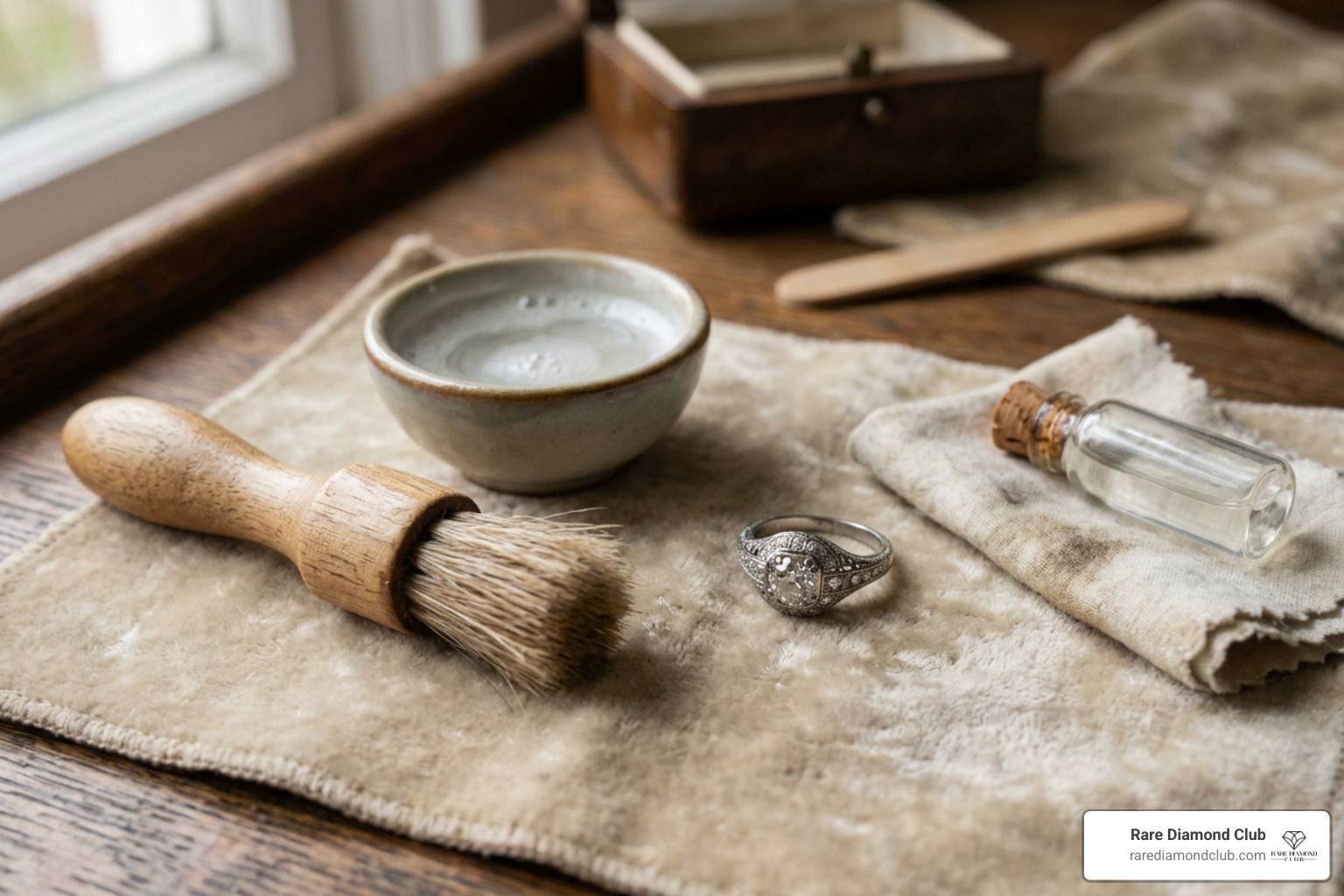
Over decades of wear, platinum develops a soft, satin-like finish known as a patina. Unlike gold, which loses metal when scratched, platinum simply shifts micro-particles of metal aside. Many collectors cherish this vintage patina because it highlights the antique character of the ring. However, if you prefer a mirror shine, a professional jeweler can gently polish it back to a high gloss.
Follow these simple rules to preserve your heirloom piece:
- Gentle Cleaning at Home: Soak your ring in a bowl of warm water mixed with a few drops of mild dish soap. Use an ultra-soft toothbrush to gently remove dirt from under the diamond setting and filigree openings. Avoid harsh chemical cleaners or steam units that could dislodge vintage accent stones.
- Skip Ultrasonic Cleaners for Accent Stones: While diamonds and platinum can handle ultrasonic waves, delicate calibré-cut emeralds, onyx, or sapphires often found in vintage mountings can crack or loosen under violent vibrations.
- Schedule Annual Inspections: Have a trusted bench jeweler check the security of your prongs, bezels, and filigree joints once a year.
- Safe Storage: Always store your vintage ring in a dedicated fabric-lined jewelry box away from other pieces. Diamonds can easily scratch other diamonds or softer gemstones if left loose in a dish.
Frequently Asked Questions About Vintage Engagement Rings
What is the average price range for an authentic Art Deco platinum diamond ring?
Pricing varies widely based on center diamond specs, metal weight, and maker provenance:
- $1,000 – $2,500: Authentic filigree platinum rings featuring center diamonds between 0.25ct and 0.50ct (often Old Mine or Old European cuts) with rose-cut accents.
- $3,000 – $7,500: Mid-tier Art Deco rings showcasing GIA-certified center diamonds from 0.75ct to 1.50ct with elaborate hand engraving and sapphire side accents.
- $10,000 – $35,000+: High-end museum-quality pieces featuring 2.00 to 4.00+ carat antique diamonds, exceptional G/H color, VS clarity ratings, and pristine platinum wirework.
Can an antique platinum filigree ring be safely resized?
Yes, but with limits. If the bottom of the platinum band (the shank) is plain without engraving, a skilled jeweler can safely resize the ring up or down by 1 to 2 sizes. However, if the pierced filigree or wheat engraving extends all the way around the band, resizing can stretch or distort the geometric pattern. In those cases, laser welding is required to preserve the structural integrity and design continuity.
How can I verify if an Art Deco ring is authentic or a modern reproduction?
To spot an authentic 1920s original versus a modern reproduction:
- Examine Tool Marks & Wear: Authentic period rings show soft, natural wear along high-contact edges and inside the shank. Modern reproductions often show crisp cast lines or cast pitted surfaces inside hard-to-reach openwork rather than clean hand-sawed edges.
- Identify the Diamond Cut: True period pieces usually house Old Mine, Old European, Transitional, or early Asscher cut diamonds. If a ring claimed to be from 1920 has a modern round brilliant diamond with razor-thin girdles, either the stone was replaced later or the mounting is a modern reproduction.
- Check Metal Stamps: Look for period-appropriate hallmarks. Modern reproductions often carry modern laser-etched font stamps, whereas vintage hallmarks were hand-stamped, showing light fading from decades of wear.
Conclusion
An art deco platinum diamond ring is far more than an exquisite piece of fine jewelry—it is a wearable work of art that embodies the courage, architectural brilliance, and craftsmanship of a transformative era. Whether you fall in love with a 1920s original featuring a warm Old European cut diamond or opt to create a modern custom interpretation, the contrast of gleaming platinum, crisp geometry, and intricate hand detailing never goes out of style.
At Rare Diamond Club, we celebrate this rich heritage by working with top-tier materials—including dense, durable platinum and exceptional G/H color, VS clarity diamonds—to craft heirloom-quality pieces tailored to your exact vision. Whether you are searching for inspiration or ready to bring your dream engagement ring to life, Explore Bespoke Fine Jewelry with our expert design team today.