


Why Natural Diamonds Remain Exceptional
A natural diamond is a crystal of carbon formed deep inside Earth under extreme heat and pressure, usually over 1 to 3.5 billion years. Most form about 150 to 250 kilometers below the surface, then reach it through ancient volcanic activity. Its rarity, brilliance, and permanent place in Earth's history make it a distinctive choice for fine jewelry and future heirlooms.
Unlike lab-grown diamonds, natural diamonds were created by geological processes rather than made in a laboratory. Each stone has its own formation history, internal features, and journey from rough crystal to polished gem.
For buyers, the key is to look beyond size alone. A trusted grading report, strong cut quality, and transparent sourcing help confirm authenticity and reveal what makes a particular diamond valuable.
This guide explains how natural diamonds form, how to verify and compare them, what the 4Cs mean, and how to select and care for a diamond worthy of a special occasion.
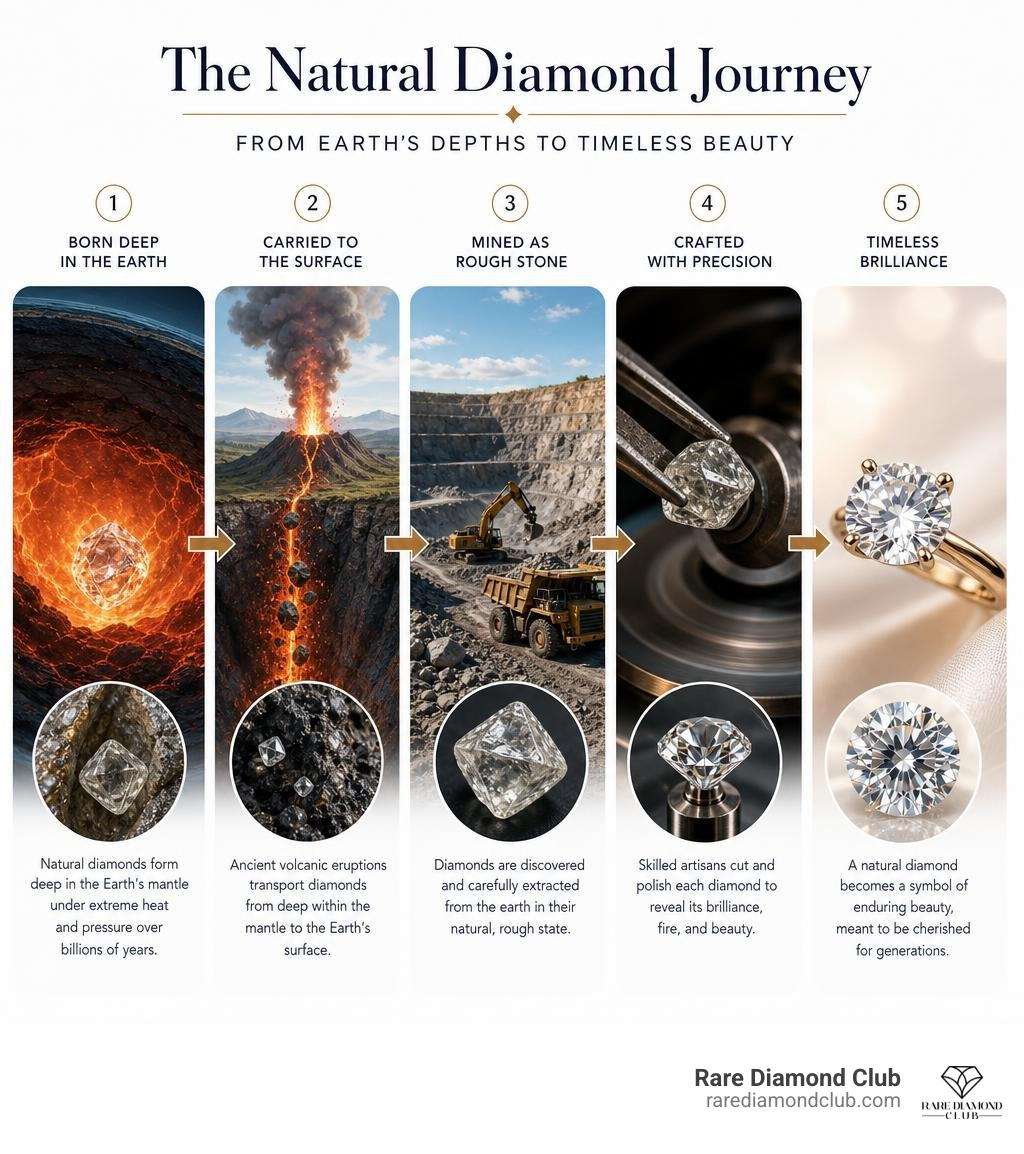
What Is a Natural Diamond and How Does It Form?
At its core, a diamond is the only gemstone composed entirely of a single element: pure carbon. Deep beneath our feet, intense temperatures exceeding 1,050 degrees Celsius and crushing pressures above 45 kilobars force carbon atoms into a tight, isometric-cubic tetrahedral crystal lattice. This unique molecular architecture gives diamond the highest hardness (ranking a perfect 10 on the Mohs scale) and highest thermal conductivity of any known natural material on Earth.
Diamonds do not form from coal—that is a popular myth! Instead, mantle carbon crystallized billions of years before the first land plants even existed. While most diamonds originate between 150 and 250 kilometers (93 to 155 miles) deep, rare "super-deep" stones have crystallized at extreme depths reaching up to 800 kilometers (500 miles).
These crystals remained locked in the mantle until supersonic, deep-source volcanic eruptions blasted upward through the crust, forming vertical geological formations called kimberlite and lamproite pipes. These magma elevators delivered the diamonds to reachable depths without vaporizing them into graphite. To explore the remarkable mineral physics behind this transformation, see these properties for industrial and gem use.
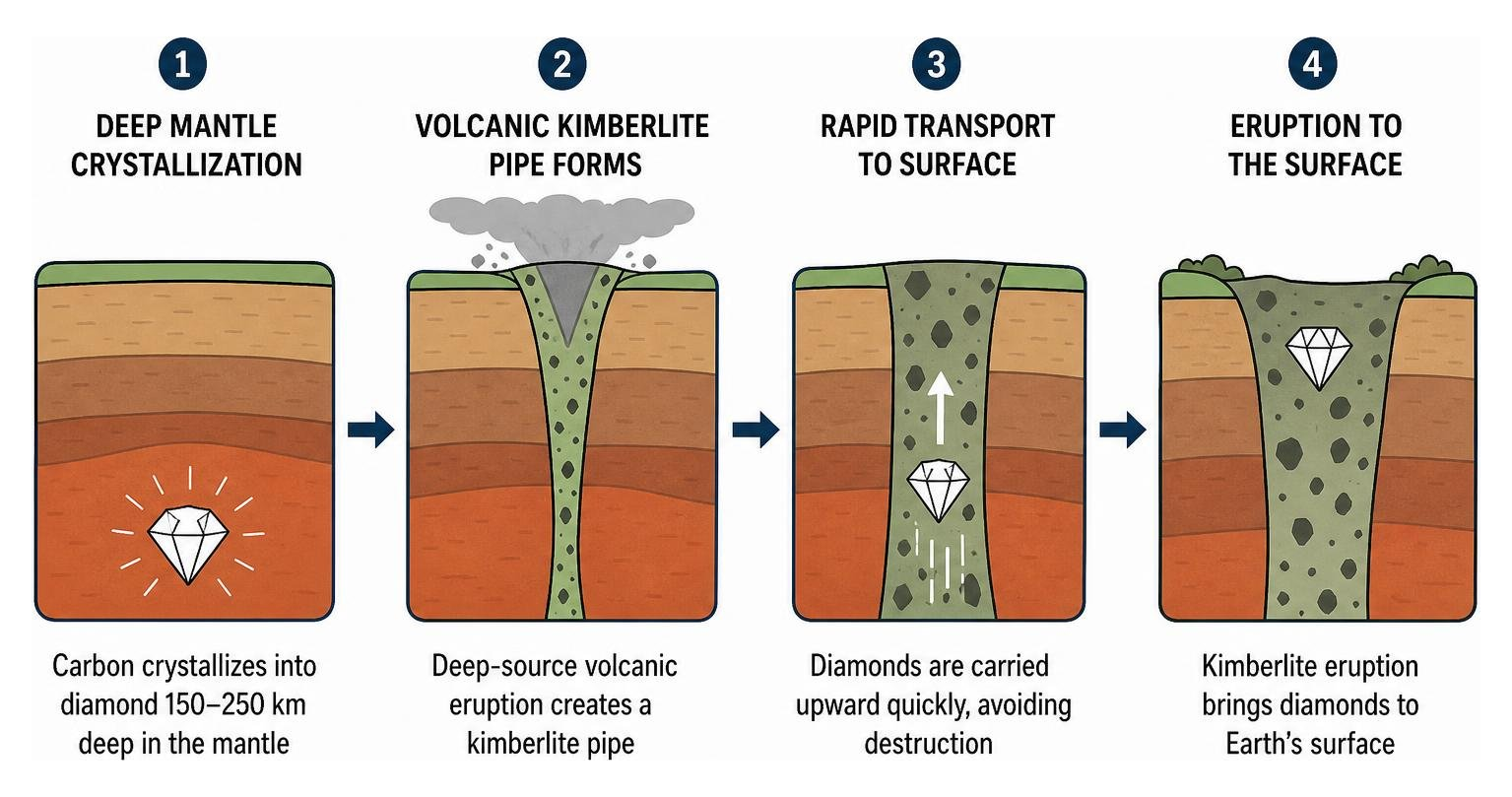
Geological Journey and Global Mining Origins
Commercial diamond mining takes place primarily on ancient continental stable crusts known as cratons. Roughly 49% of all gem-quality stones originate from Central and Southern Africa (such as Botswana, South Africa, and Namibia), alongside major operations across Canada, Australia, and Russia.
Rough diamonds are extracted through massive open-pit operations, underground shaft mining, or alluvial mining (retrieving stones washed into riverbeds and ocean beaches). On average, processing plants must crush and sort through one million parts of host rock to uncover a single part of gem diamond.
Annually, about 130 to 135 million carats of rough material are mined worldwide. However, roughly 80% of mined stones are heavily included or discolored, making them unsuitable for fine jewelry. Instead, these stones serve crucial roles in high-precision abrasives, optical windows, and industrial cutting tools. The remaining gem-quality rough is sorted, traded, and sent to master cutting hubs. In fact, approximately 92% of the world's diamonds are cut and polished in Surat, India.
When shaped and hand-set into an exquisite Natural Diamond Solitaire Engagement Ring, that billions-of-years-old crystal is transformed into a breathtaking work of art.
The 4Cs: Evaluating Gemstone Quality and Value
To establish a universal language for diamond quality, the Gemological Institute of America developed the 4Cs: Cut, Color, Clarity, and Carat Weight. These four parameters dictate the rarity, optical beauty, and market value of every stone. For authoritative definitions and grading scales, explore the standard GIA diamond grading criteria.
| The 4C Factor | Gemological Scale | Value Impact | Buyer Strategy |
|---|---|---|---|
| Cut | Excellent, Very Good, Good, Fair, Poor | Highest optical impact on sparkle, fire, and brilliance. | Never compromise here; prioritize Excellent or Ideal cut grades. |
| Color | D (Colorless) through Z (Light Yellow/Brown) | Rarity increases drastically from D to F; prices step up per tier. | G to H grades offer near-colorless appearance at excellent value. |
| Clarity | FL/IF (Flawless) down to I1–I3 (Included) | Evaluates internal inclusions and surface blemishes under 10x magnification. | VS1–VS2 provides guaranteed eye-clean perfection for everyday wear. |
| Carat | Metric Carat (1 carat = 0.20 grams / 100 points) | Exponential price increases at milestone weights (0.50ct, 1.00ct, 2.00ct). | Consider buying just under milestone weights (e.g., 0.95ct) to maximize value. |
Cut and Carat Weight
Cut does not simply refer to a diamond's shape—it measures how masterfully the facets interact with light. A well-proportioned diamond bounces light internally from one facet to another and reflects it back through the crown to the viewer's eye, producing three visual phenomena:
- Brilliance: The internal and external white light reflections.
- Fire: The dispersion of white light into vivid spectral rainbow colors.
- Scintillation: The dynamic pattern of sparkle and light flashes created when the diamond moves.
A poorly cut stone leaks light through its sides or bottom, making it appear lifeless and dull regardless of how large it is.
Carat weight measures physical mass rather than visual surface area. Because large rough crystals are exceptionally rare, price curves do not scale linearly. A single 2.00-carat diamond commands a significantly higher price than two individual 1.00-carat stones of equivalent cut, color, and clarity.
For maximum brilliance, a Natural Diamond Round Solitaire Engagement Ring delivers timeless proportions. If you prefer elongated elegance that maximizes finger coverage per carat, consider a stunning Natural Diamond Solitaire Oval Engagement Ring.
Color, Clarity, and Fluorescence
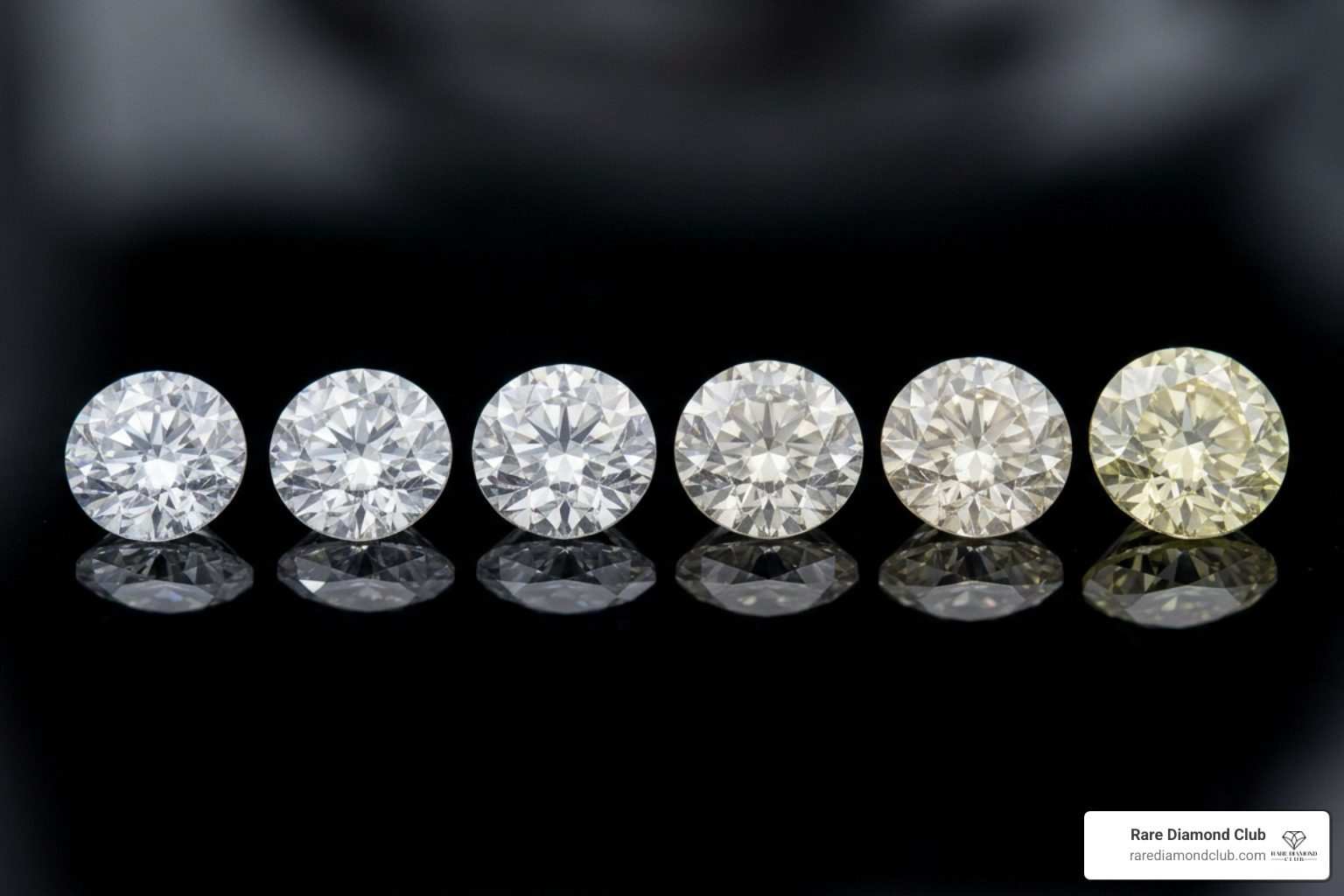
The diamond color scale grades the absence of body color on an alphabetical spectrum from D (entirely colorless) to Z (noticeable yellow or brown tint). Most natural diamonds contain trace amounts of nitrogen trapped within their crystal matrix during formation, which imparts faint warm undertones. Stones graded D through F represent the pinnacle of rarity, while G through H offer an icy, near-colorless aesthetic when set in precious metals like platinum or white gold.
Beyond the Z grade lie "fancy-color" diamonds—naturally occurring marvels colored by specific atomic phenomena. Boron impurities yield rare blue diamonds (like the famous Wittelsbach-Graff and Hope diamonds), crystal lattice distortions generate romantic pink and red hues, and natural radiation exposure creates vibrant green stones.
Clarity evaluates the internal features (inclusions) and surface irregularities (blemishes) formed during crystallization:
- FL / IF (Flawless / Internally Flawless): No inclusions visible under 10x magnification.
- VVS1 / VVS2 (Very, Very Slightly Included): Minute characteristics extremely difficult for skilled graders to locate.
- VS1 / VS2 (Very Slightly Included): Minor inclusions visible under 10x magnification, but completely invisible to the naked eye.
- SI1 / SI2 (Slightly Included): Inclusions noticeable under magnification; may occasionally be eye-visible in fancy cuts.
- I1 / I2 / I3 (Included): Inclusions obvious under magnification and often visible to the unaided eye, impacting both brilliance and durability.
Additionally, between 25% and 35% of natural diamonds exhibit fluorescence when exposed to long-wave ultraviolet light, emitting a soft blue glow. In near-colorless and faint yellow stones (I to M grades), medium-to-strong blue fluorescence can make the gem appear visually whiter in natural sunlight without affecting structural integrity.
Authenticity and Verification of Natural Diamonds
Understanding the difference between natural diamonds, lab-created diamonds, and non-diamond simulants is vital when curating a fine jewelry collection. While synthetic diamonds share identical chemical, optical, and physical properties with mined stones, diamond simulants do not.
A simulant—such as moissanite or cubic zirconia—is an imitation material with entirely different chemical structures:
- Moissanite is composed of silicon carbide. It ranks at 9.25 to 9.5 on the Mohs scale and exhibits extreme double refraction, creating an unmistakable disco-ball fire.
- Cubic Zirconia (CZ) is synthetic zirconium dioxide. It is significantly heavier (higher specific gravity), softer (8.5 Mohs), and quickly scratches and turns cloudy over time.
To learn more about gemological classification, explore the scientific background on Diamond (gemstone)).
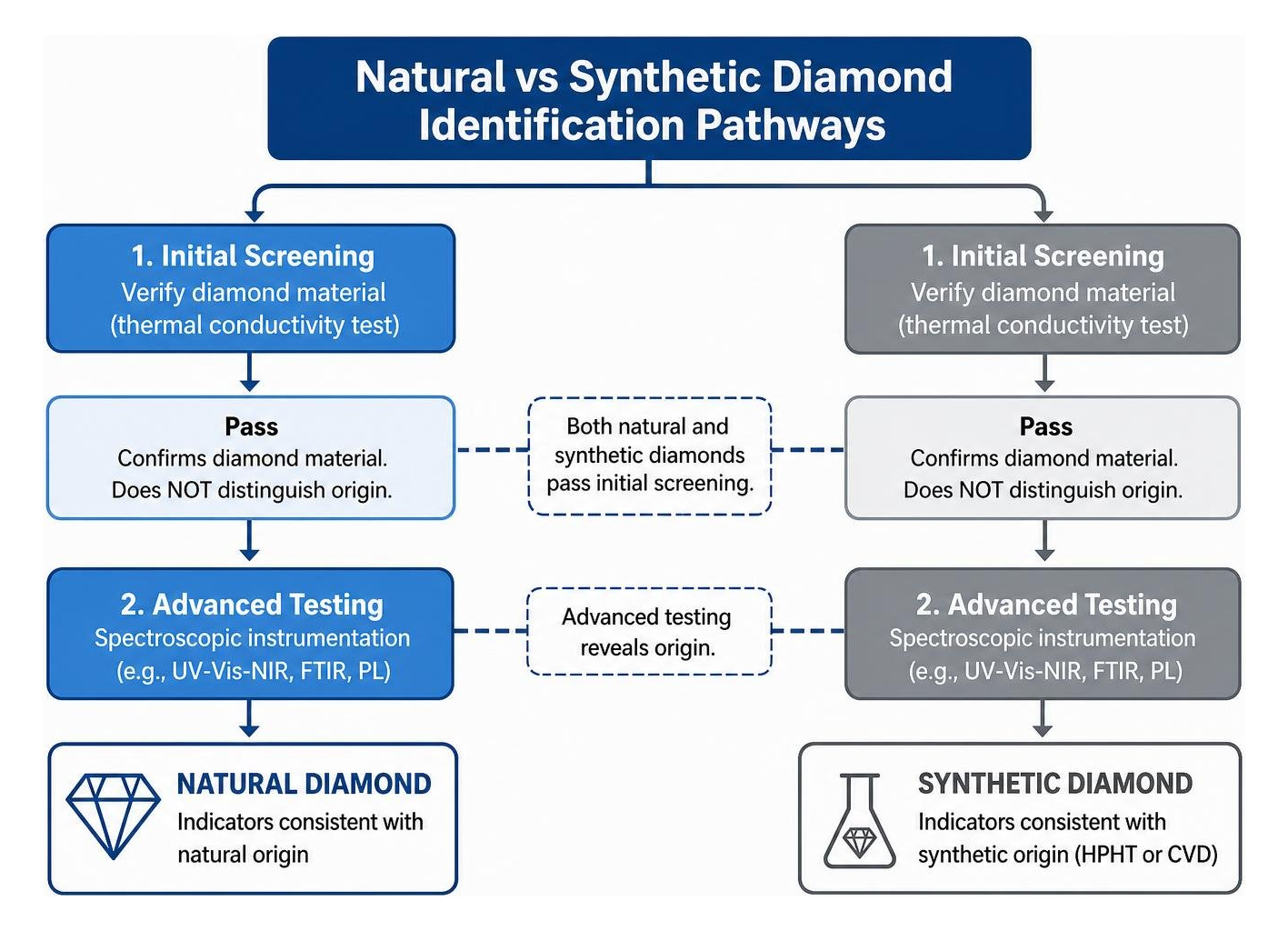
Distinguishing Features and Gemological Verification
Because lab-grown diamonds (produced via High-Pressure High-Temperature [HPHT] or Chemical Vapor Deposition [CVD] methods) are chemically identical to natural stones, basic thermal conductivity pens cannot distinguish between them. Both register as authentic diamond material.
Professional gemological laboratories identify natural stones using sophisticated spectroscopic instrumentation:
- Growth Morphology: Natural stones exhibit octahedral growth lines formed over millions of years, whereas HPHT synthetics show cuboctahedral patterns and CVD stones display flat, tabular growth layers.
- Spectroscopic Analysis: Photoluminescence and FTIR spectrometers detect trace nitrogen aggregation states that occur exclusively during geological timescales.
- Laser Inscriptions: Certified diamonds feature microscopic, tamper-evident laser engravings on the girdle indicating their report number and natural provenance.
At Rare Diamond Club, every piece in our made-to-order collections is crafted using hand-selected, independently verified natural diamonds—primarily G/H color and eye-clean VS clarity—set in solid gold or enduring platinum.
Selecting Diamond Shapes and Fine Jewelry Settings
Choosing the perfect diamond silhouette allows you to showcase individual style and craftsmanship. Diamond shapes fall into two primary categories: brilliant cuts (engineered for light return) and step cuts (designed for sleek, geometric transparency).

Classic and Modern Ring Designs
The architectural cut of your center stone dictates the personality of your ring setting:
- Round Brilliant: The gold standard of fire and brilliance, featuring 57 or 58 perfectly mathematically aligned facets.
- Emerald Cut: An aristocratic step cut featuring parallel rectangular facets that produce a sophisticated "hall of mirrors" reflection. For an elevated architectural look, nothing surpasses a Natural Diamond Solitaire Cathedral Emerald Cut Engagement Ring.
- Oval & Cushion Cuts: Blending classic brilliant sparkle with contemporary silhouettes that flatter the hand.
Modern settings offer versatile ways to accentuate your chosen shape. A hidden halo setting—such as our Natural Diamond Round Hidden Halo Engagement Ring—adds an intimate ribbon of pavé diamonds beneath the center basket for surprise sparkle from every side profile.
If you appreciate symbolic romance, a Natural Diamond 3 Stone Trellis Engagement Ring gracefully balances three diamonds to represent your past, present, and future together.
Necklaces, Bracelets, and Earrings
The durability of natural diamonds makes them the ultimate choice for daily-wear fine jewelry. Whether building an essential capsule wardrobe or celebrating a momentous milestone, fine diamond accessories transition effortlessly from daytime meetings to black-tie galas:
- Tennis Bracelets: A continuous line of channel- or prong-set diamonds. Our Natural Diamond 4 Prong Tennis Bracelet Round delivers fluid comfort, diamond brilliance, and maximum security on the wrist.
- Pendants and Necklaces: A delicate Natural Diamond Solitaire Bezel Set Pendant Necklace provides a sleek, modern frame that protects the diamond girdle while laying flush against the collarbone.
- Diamond Studs and Huggies: From classic shared-prong studs to modern huggie hoops, natural diamond earrings bring flattering illumination to your face with every turn.
Investment Potential and Jewelry Maintenance
Natural diamonds occupy a unique position in the luxury world as portable, tangible stores of value and cherished family heirlooms. Unlike synthetic alternatives—which can be produced in unlimited quantities in industrial facilities—the Earth’s supply of natural diamonds is finite. As historic mines mature and primary production stabilizes, high-quality natural diamonds maintain genuine market liquidity, enduring cultural prestige, and multi-generational emotional value.
While everyday commercial stones should primarily be purchased for their personal beauty and symbolic joy, rare top-tier specimens (such as large D Flawless diamonds and vivid fancy colors) have historically served as stable luxury assets at premier international auction houses.
Caring for Your Natural Diamond Jewelry
Although diamond is the hardest mineral known to science, it is naturally lipophilic—meaning it acts like a magnet for skin oils, lotions, soaps, and dust. A light film of oil across the pavilion facets will dull even an Ideal-cut diamond's optical sparkle.
To keep your natural diamond jewelry in pristine condition, follow these simple care guidelines:
- Routine Home Cleaning: Soak your jewelry for 15 to 20 minutes in a small bowl of lukewarm water mixed with a few drops of mild, degreasing dish soap.
- Gentle Brushing: Gently scrub behind the diamond basket, under the prongs, and around the setting using an extra-soft baby toothbrush.
- Rinse and Dry: Thoroughly rinse under clean running water (ensure the sink drain is securely plugged!) and pat dry with a lint-free microfiber cloth.
- Annual Maintenance Checks: Have your fine jewelry professionally inspected once a year to ensure prongs remain tight, secure, and properly aligned.
- Mindful Wearing: Remove your diamond rings and bracelets before heavy weightlifting, gardening, rock climbing, or handling harsh household chemicals like chlorine bleach.
Frequently Asked Questions About Fine Diamonds
How can I verify that a diamond is authentic and natural?
Always insist on purchasing diamonds accompanied by an independent grading certificate from globally recognized gemological laboratories such as the GIA. These detailed reports document the precise 4Cs grading, confirm the stone's geological origin, and map its unique internal inclusion fingerprint. Most certified diamonds also carry a microscopic laser inscription on the girdle that can be verified under a 20x jeweler's loupe.
Are modern natural diamonds ethically sourced and conflict-free?
Yes. Today, more than 99% of global rough diamonds are certified conflict-free through the Kimberley Process Certification Scheme (KPCS) and the World Diamond Council’s System of Warranties. Established in 2003 under United Nations mandates, this international regulatory framework tracks diamonds from mine to market to eliminate illicit trading. Furthermore, responsible diamond mining drives major socioeconomic development in producer nations, funding public education, hospitals, clean-water infrastructure, and environmental conservation projects.
How does diamond hardness differ from diamond toughness?
Hardness and toughness are two completely different physical properties. Hardness describes a mineral’s resistance to surface scratching; ranking 10 on the Mohs scale, a diamond can only be scratched by another diamond. Toughness, on the other hand, measures resistance to chipping or breaking upon hard mechanical impact. Because diamonds have four natural cleavage directions where atomic bonds are slightly weaker, a direct, sharp blow against a hard surface can cause a stone to chip. Choosing protective jewelry mountings—such as bezel or cathedral prongs—helps safeguard these natural treasures for a lifetime of daily wear.
Conclusion
A natural diamond is an extraordinary triumph of the natural world—a billion-year-old journey from the depths of Earth's mantle to an enduring symbol of love and achievement. Its optical fire, timeless resilience, and geological rarity make it a gemstone without equal.
At Rare Diamond Club, we celebrate this remarkable heritage through bespoke design, heirloom-grade materials, and uncompromising standards. Explore our complete collection of custom luxury diamond jewelry to find or create a one-of-a-kind natural diamond piece designed to shine for generations.