


The Biggest Natural Diamond in the World, at a Glance
The biggest natural diamond in the world by gem-quality rough weight is the Cullinan Diamond. Found in South Africa in 1905, it weighed an extraordinary 3,106 carats, or 621.2 grams, before cutting.
That record needs one important note: the 3,167-carat Sergio is heavier, but it is a black carbonado diamond rather than a gem-quality crystal. The Cullinan remains the largest rough diamond ever found that could produce the clear, polished gems associated with fine jewelry.
Its story did not end at the mine. The rough stone was divided into 105 diamonds, including Cullinan I, the 530.2-carat Great Star of Africa, now mounted in the Sovereign's Sceptre with Cross. From a deep South African mine to Britain's Crown Jewels, the Cullinan is a rare meeting point of geology, craftsmanship, and royal history.
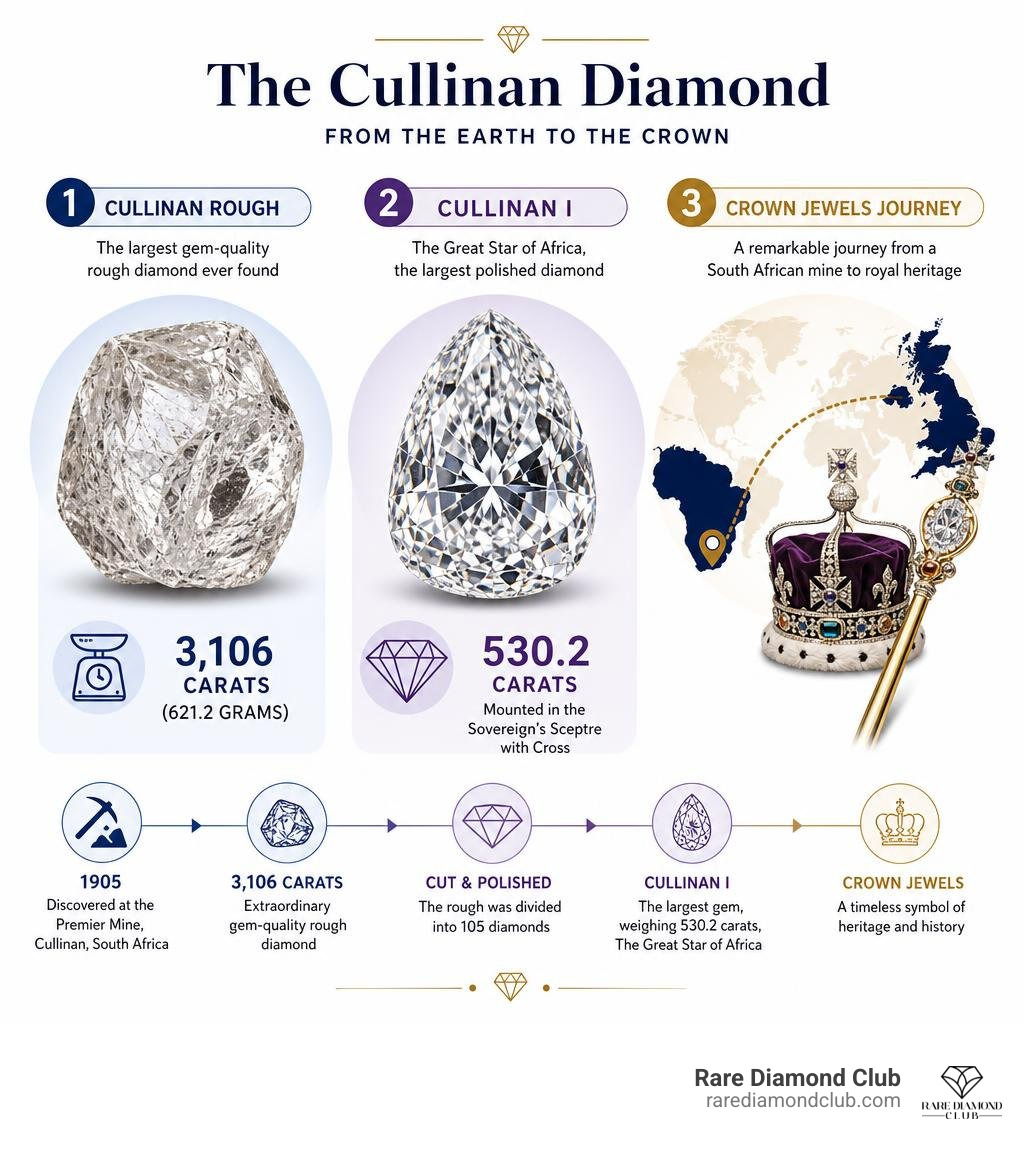
The Cullinan Diamond: The Biggest Natural Diamond in the World
On the afternoon of January 26, 1905, superintendent Frederick Wells conducted a routine inspection 18 feet (5.5 meters) below the surface at the Premier No. 2 mine in Cullinan, South Africa. A flash of light caught his eye along the open wall. Wells initially suspected that fellow miners had embedded a large chunk of glass as a practical joke. When he extracted the crystal with his pocketknife, he was holding a mineral specimen measuring roughly 4 by 2.5 by 2 inches, weighing 3,106 carats (621.20 grams).
Named after Sir Thomas Cullinan—who had discovered the kimberlite pipe three years prior—the crystal exhibited structural perfection. Formed roughly 1.18 billion years ago within the Earth's mantle transition zone at depths between 410 and 660 kilometers, the diamond featured pure Type IIa carbon composition with an exceptional blue-white color. A tiny interior air pocket created rainbow patterns under focused light, known as Newton's rings.
Following its discovery, the Transvaal Colony government purchased the stone on October 17, 1907, for £150,000 (roughly equivalent to £21 million in modern currency). Under the leadership of Prime Minister Louis Botha, the government voted to present the diamond to Britain's King Edward VII as a gesture of reconciliation after the Boer War.
Transporting a gem of this scale required strategic security measures. The authorities organized an elaborate diversion: an armed contingent and Scotland Yard detectives publicly escorted a locked iron safe containing a replica aboard the steamer RMS Kenilworth Castle. Meanwhile, the actual 3,106-carat Cullinan was packed in an unmarked cardboard parcel and shipped to London via standard registered post for three shillings. To discover more about the diamond's journey and historical significance, explore the Cullinan diamond history and significance through detailed historical records, and visit our Diamond Education resource to learn how crystal structure and grading standards shape natural gems.
Cleaving the 3,106-Carat Wonder: Joseph Asscher's Masterwork
Once in Europe, King Edward VII entrusted the cutting to the I.J. Asscher Diamond Company in Amsterdam, the premier cleaving firm of the era. Joseph Asscher spent several months studying the crystal's octahedral cleaving planes and internal grain structure before attempting a cut.
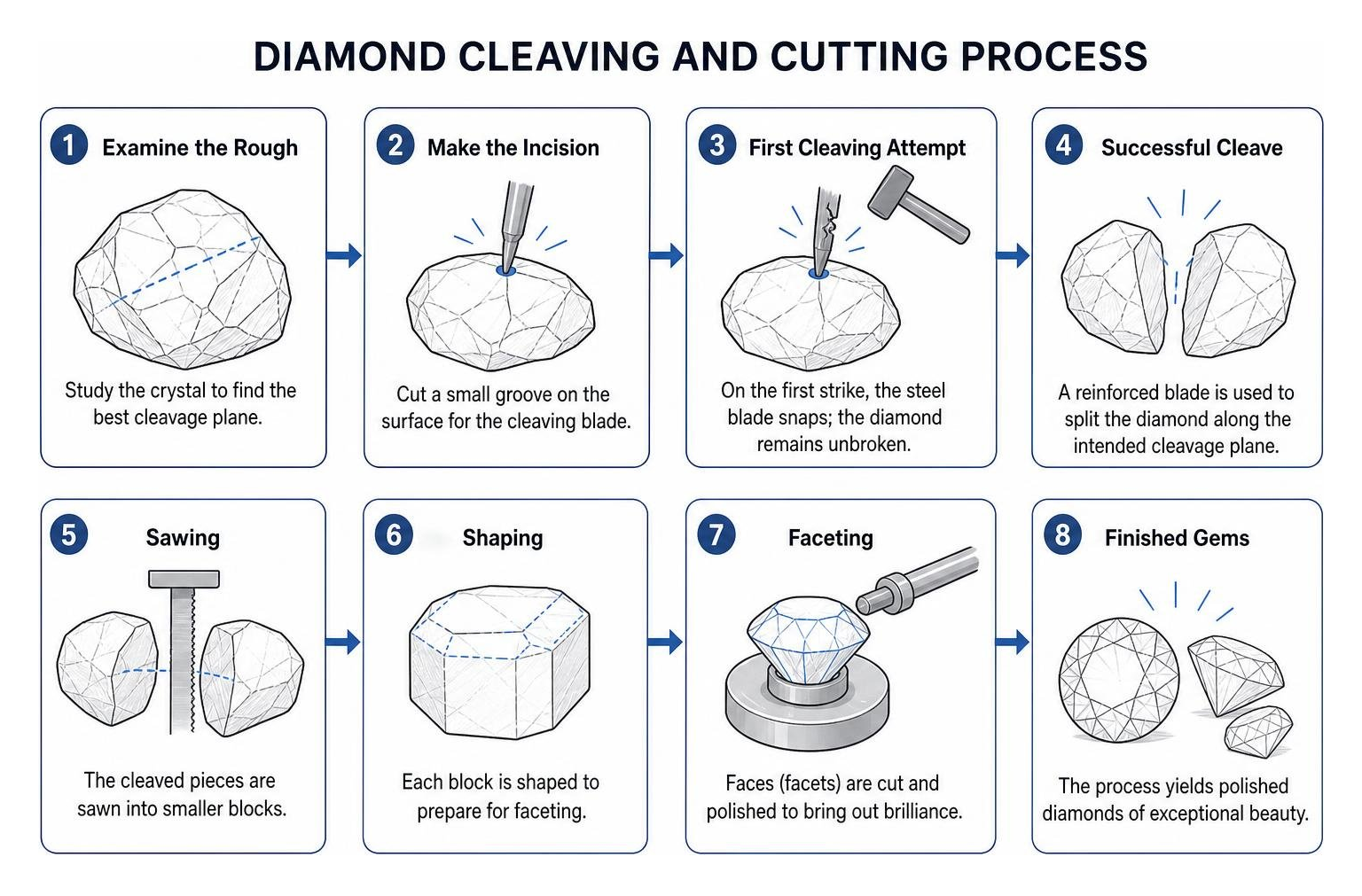
On February 10, 1908, Asscher placed a custom-forged steel cleaving blade into a 0.5-inch (13 mm) incision on the stone's surface. On the initial strike, the steel blade snapped under the immense hardness of the diamond while the crystal remained unbroken.
Using a reinforced second blade, Asscher struck the diamond again, splitting the 3,106-carat crystal precisely along its intended cleavage plane. While popular legend claims Asscher fainted immediately after the strike, historical records confirm he maintained composure throughout the operation.
Cleaving, sawing, and faceting the stone required eight months of continuous labor, with three master polishers working 14-hour days. The yield produced:
- 9 major named gemstones (numbered Cullinan I through IX), totaling 1,055.89 carats
- 96 minor brilliant-cut stones
- 9.5 carats of unpolished end pieces
The Major Gems: From the Great Star of Africa to Minor Brilliants
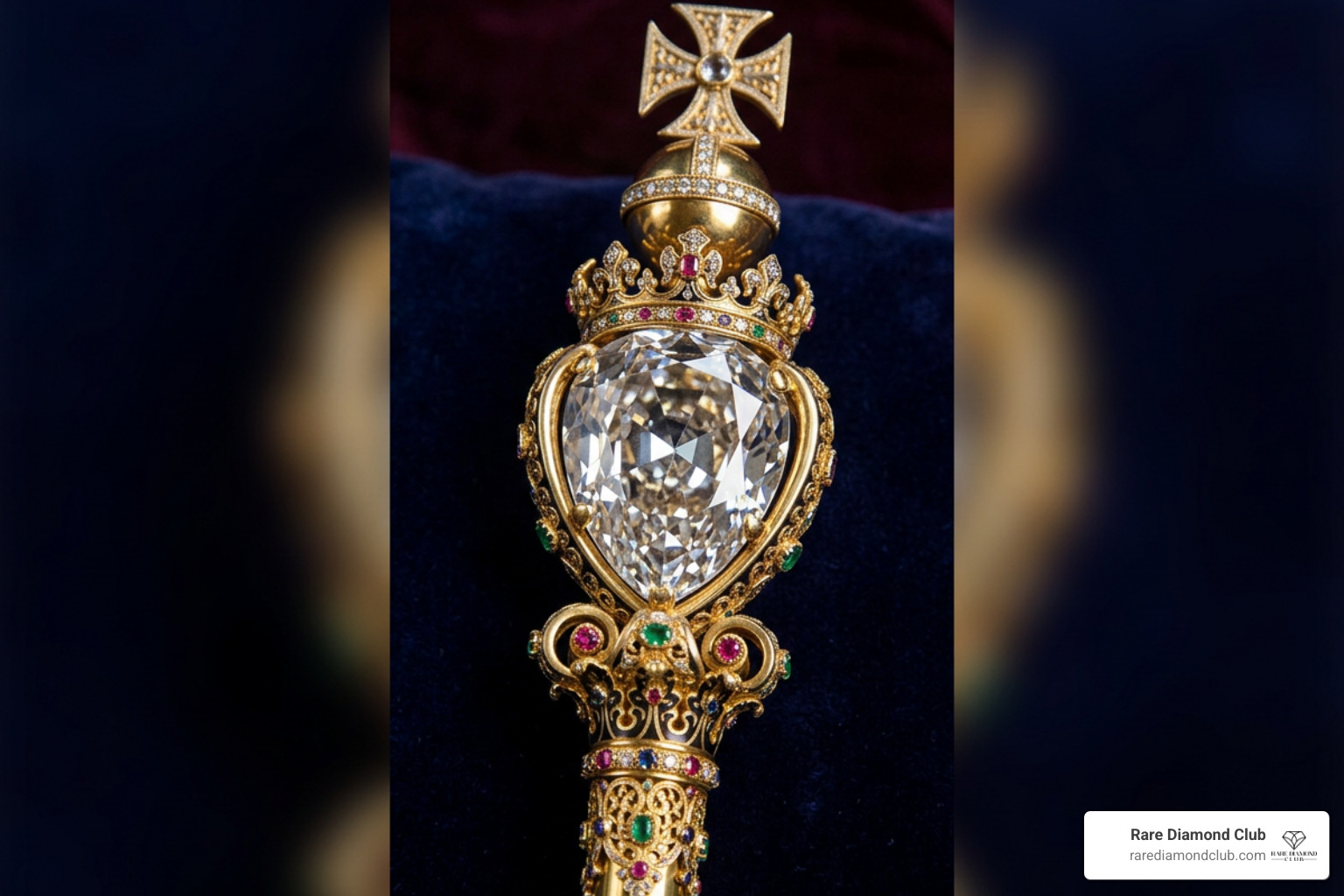
The primary gems cut from the Cullinan rough rank among the finest diamonds ever crafted. A comprehensive detailed breakdown of the Cullinan Diamond shows the extraordinary quality distribution across all nine major stones:
- Cullinan I (The Great Star of Africa): Weighing 530.2 carats with 74 facets, this drop-shaped pendeloque cut is the largest clear cut diamond in the world. King Edward VII had it mounted into the Sovereign's Sceptre with Cross in 1910.
- Cullinan II (The Second Star of Africa): A 317.4-carat cushion-cut diamond featuring 66 facets, mounted into the front band of the Imperial State Crown, directly beneath the Black Prince's Ruby.
- Cullinan III and Cullinan IV: Weighing 94.4 carats (pear shape) and 63.6 carats (cushion cut) respectively. Affectionately nicknamed "Granny's Chips" by Queen Elizabeth II, they were set into a versatile brooch that Queen Mary originally commissioned.
- Cullinan V: An 18.8-carat heart-shaped diamond set in the center of a platinum stomacher brooch.
- Cullinan VI & Cullinan VIII: Weighing 11.5 carats (marquise cut) and 6.8 carats (cushion cut), often worn together as an integrated brooch.
- Cullinan VII: An 8.8-carat marquise cut set into the Delhi Durbar necklace.
- Cullinan IX: A 4.39-carat pear-shaped diamond set in a platinum ring.
Cullinan I and Cullinan II remain on public display within the Jewel House at the Tower of London as core elements of the British Crown Jewels.
The World's Top Record-Holding Natural Rough Diamonds
While the Cullinan stands as the biggest natural diamond of gem quality, geological history records several remarkable finds across different diamond categories.
| Diamond Name | Carat Weight | Discovery Year | Location / Mine | Diamond Type / Quality | Current Status |
|---|---|---|---|---|---|
| Sergio | 3,167 ct | 1895 | Bahia, Brazil | Carbonado (Non-Gem) | Broken for industrial drill bits |
| Cullinan | 3,106 ct | 1905 | Premier Mine, South Africa | Type IIa Gem Quality | Cut into 105 stones (Crown Jewels) |
| Motswedi | 2,492 ct | 2024 | Karowe Mine, Botswana | Type IIa Gem Quality | Intact rough crystal |
| Sewelô | 1,758 ct | 2019 | Karowe Mine, Botswana | Near-Gem / Industrial Coat | Intact rough specimen |
| Lesedi La Rona | 1,111 ct | 2015 | Karowe Mine, Botswana | Type IIa Gem Quality | Cut into 302 ct Graff Lesedi La Rona |
| Karowe 998 | 998 ct | 2020 | Karowe Mine, Botswana | Type IIa Gem Quality | Uncut rough crystal |
| Excelsior | 995.2 ct | 1893 | Jagersfontein, South Africa | Type IIa Gem Quality | Cut into 21 individual stones |
Rough Giants: Ranking the Biggest Natural Diamond in the World Contenders
The Sergio carbonado, discovered in Bahia, Brazil, in 1895, holds the absolute weight record for any rough diamond at 3,167 carats. Carbonados are opaque, porous, polycrystalline aggregates of diamond, graphite, and amorphous carbon. Because of their structural density and lack of single-crystal transparency, carbonados cannot yield faceted gem-quality jewelry; the Sergio was broken down into industrial drilling bits.
In August 2024, the landscape of mega-diamonds shifted with the recovery of the 2,492-carat Motswedi diamond from the Karowe Mine in Botswana. The stone was recovered intact thanks to specialized X-ray Transmission (XRT) recovery units, which identify diamond carbon density within bulk ore before crushing circuits can damage large crystals. The Motswedi Diamond discovery and XRT technology highlights how modern recovery methods protect delicate Type IIa crystals from fracture. Named "Motswedi" (Setswana for "a water spring"), it ranks as the second-largest rough diamond ever unearthed.
The Karowe Mine has yielded multiple historic stones, including the 1,758-carat Sewelô in 2019, the Lesedi La Rona 1,111 carats discovery in 2015 (which yielded a 302.37-carat principal emerald-cut gem), and a 998-carat Karowe discovery in 2020. Prior to the Cullinan, the 995.2-carat Excelsior diamond, found in South Africa in 1893, was the largest known gem crystal.
Golden Jubilee vs. Cullinan I: The Largest Cut and Polished Stones
A common point of confusion in gemology is the difference between the largest rough diamond and the largest cut diamond:
- The Golden Jubilee (545.67 carats): Discovered at the Premier Mine in 1985 (weighing 755.5 carats rough), this fancy yellow-brown stone was fashioned by master cutter Gabi Tolkowsky into a fire rose cushion cut. It was presented to King Bhumibol Adulyadej of Thailand in 1997 for his Golden Jubilee. It remains the largest faceted cut diamond of any color.
- Cullinan I (530.20 carats): While 15.47 carats lighter than the Golden Jubilee, Cullinan I remains the largest cut colorless (D-F range) diamond in existence.
The Modern Legacy of Historic Diamond Craftsmanship
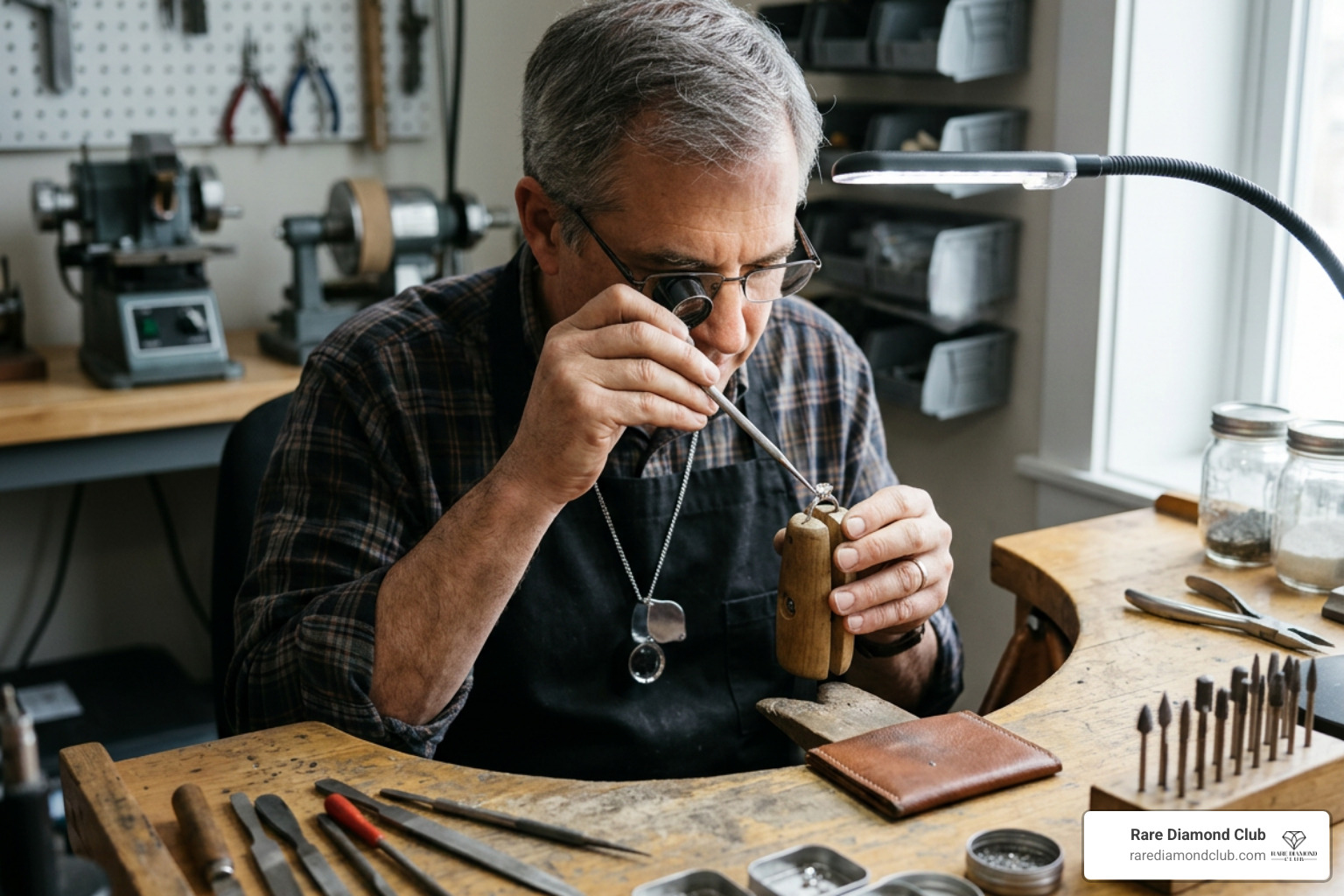
The meticulous cutting of the Cullinan set new benchmarks for precision diamond craftsmanship. In the early twentieth century, artisans relied on manual cleaving wedges and eye appraisal. Modern ateliers combine those traditional bench techniques with advanced 3D scanning, photogrammetry, and laser sawing.
Today, whether preparing a multi-carat rough crystal or hand-selecting matched side stones, gemological precision ensures light performance, symmetry, and structural integrity. At Rare Diamond Club, we honor this heritage of craftsmanship through Bespoke Design services. Clients seeking Custom Engagement Rings in New York City work directly with our master bench jewelers, choosing premium platinum settings and G/H VS natural diamonds cut for optimal brilliance.
The structural principles developed during the division of the Cullinan continue to guide classic fine jewelry forms, including hand-aligned Natural Tennis Bracelets and seamless Natural Wedding Bands.
Why the Cullinan Remains the Biggest Natural Diamond in the World in Cultural History
The Cullinan represents more than raw carat weight. Its recovery in 1905, followed by its division into foundational elements of the British royal regalia, established the standard against which all subsequent gem discoveries are measured.
The geological conditions that forged a 3,106-carat Type IIa diamond deep within the Earth's mantle are extraordinarily rare. Because large rough diamonds are frequently cleaved into smaller stones for commercial use, the Cullinan's preservation across nine major royal gems ensures its permanent place in gemological and cultural history.
Frequently Asked Questions About the Largest Natural Diamonds
What is the biggest natural diamond in the world ever discovered?
The Cullinan Diamond is the largest gem-quality natural rough diamond ever discovered. Found on January 26, 1905, at the Premier No. 2 mine in South Africa, it weighed 3,106 carats (621.20 grams).
What is the difference between the Cullinan, Sergio, and Golden Jubilee diamonds?
- Sergio (3,167 carats): The heaviest rough diamond ever found, but an opaque, non-gem carbonado used exclusively for industrial applications.
- Cullinan (3,106 carats): The largest gem-quality rough diamond ever discovered, yielding clear, faceted stones.
- Golden Jubilee (545.67 carats): The largest faceted, polished diamond in the world (a fancy yellow-brown stone), surpassing the 530.2-carat Cullinan I in total polished weight.
Where are the Cullinan diamonds kept today?
The primary stones cut from the Cullinan are held in the British Royal Collection. Cullinan I (530.2 carats) is mounted in the Sovereign's Sceptre with Cross, and Cullinan II (317.4 carats) is set in the Imperial State Crown. Both are exhibited in the Jewel House at the Tower of London. The remaining major cuts (Cullinan III through IX) are set in brooches, rings, and necklaces within the personal collection of the British royal family.
Conclusion
From its billion-year formation deep in the Earth's mantle to its historic cleaving in an Amsterdam workshop, the Cullinan Diamond remains the benchmark for natural gemstone rarity. Its journey from a rough 3,106-carat crystal to the centerpiece of the Crown Jewels demonstrates the intersection of geological wonder and master craftsmanship.
At Rare Diamond Club, we celebrate the enduring allure of natural diamonds by pairing exceptional materials with made-to-order artistry. Explore our custom fine jewelry collections and discover how timeless natural diamonds can become part of your personal legacy.