


Find the Right 2 Carat Square Diamond Ring for Your Proposal
A 2 carat square diamond ring is often the sweet spot for buyers who want strong visual presence without moving into the much higher cost of a 3-carat stone. For a proposal, choose based on three priorities:
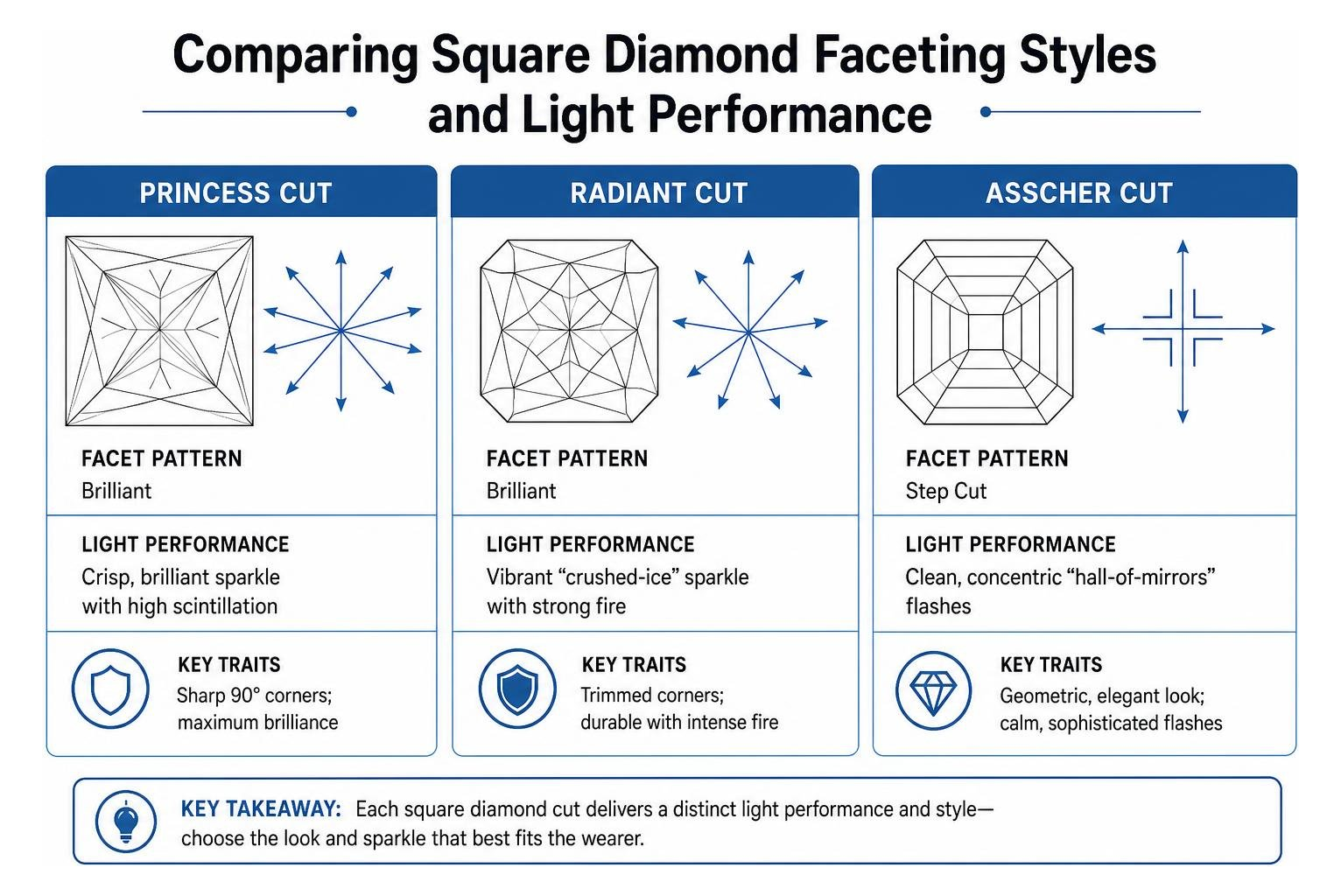
- Shape and sparkle: Pick a princess cut for crisp, brilliant sparkle, a radiant for extra fire and durability at the corners, or an Asscher for a calm, geometric step-cut look.
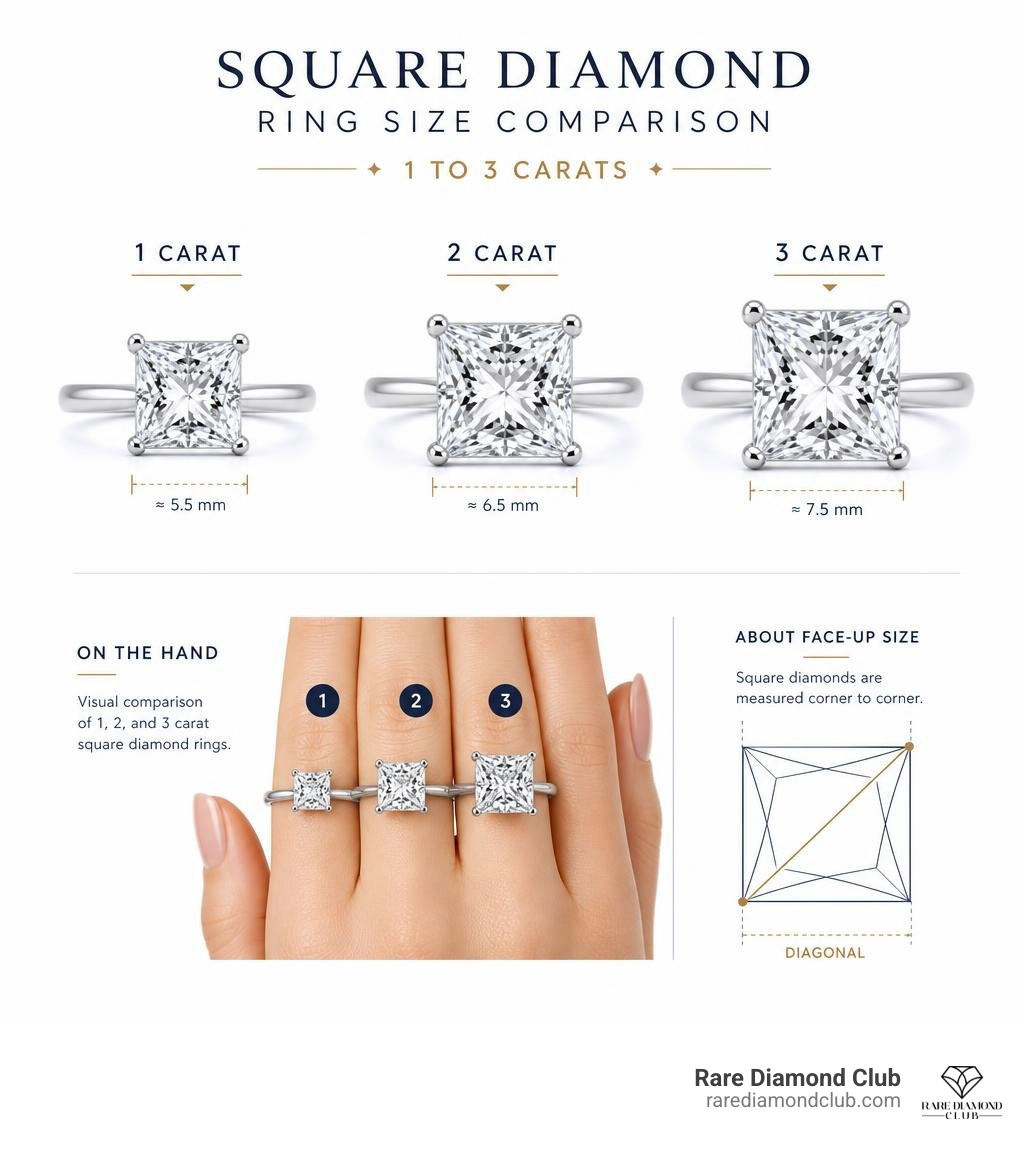
- Face-up size: A well-proportioned 2-carat square diamond typically offers noticeably more finger coverage than a 1-carat stone, while remaining easier to wear than many 3-carat rings.
- Budget and protection: Square diamonds can cost less than comparable round brilliants, but prioritize strong cut quality and protective corner prongs, especially for a princess cut.
The best choice is not simply the biggest diamond. It is the size, shape, setting, and quality level that suit the wearer’s hand, lifestyle, and proposal budget.
For many couples, 2 carats delivers the balance: a meaningful increase in visual impact from 1 carat, without the steep price-per-carat jump that can come with 3 carats. Princess cuts are a popular modern choice, while radiant and Asscher cuts offer distinct personalities and light patterns.
Rare Diamond Club offers both natural and lab-grown diamonds in diamond engagement rings, making it possible to compare appearance, quality, and budget without compromising on a design that feels personal.
Evaluating the 2 Carat Square Diamond Ring: Shapes, Cut Quality, and Sparkle
Square Diamond Cuts: Princess, Asscher, and Radiant
When shopping for square diamond engagement rings, you are not limited to a single aesthetic. The three primary square silhouettes offer entirely distinct optical personalities, facet arrangements, and durability profiles.
- Princess Cut: Accounting for roughly 30% of all diamond sales, the princess cut is the second most popular diamond shape in the world. Engineered in the 1960s and refined over decades, it features an inverted pyramid profile with sharp, 90-degree corners. It boasts a brilliant faceting pattern (typically 57 or 76 facets) designed to maximize light return and scintillation.
- Square Radiant Cut: Blending the outline of an emerald or Asscher cut with the intense brilliance of a round cut, the radiant features trimmed, cropped corners with 70 facets. This design creates a vibrant "crushed-ice" sparkle effect while eliminating fragile, needle-sharp points.
- Asscher Cut: Introduced in 1902 and iconic to the Art Deco era, the Asscher cut is a square step cut characterized by cropped corners, a high crown, and a deep pavilion. Rather than a fiery, shimmering sparkle, Asschers produce clean, concentric flashes of light known as a "hall-of-mirrors" effect.
One major financial advantage of square diamonds over round brilliant stones lies in the rough crystal yield. Natural octahedral diamond rough aligns closely with square cuts. Diamond cutters can preserve 80% to 85% of the rough stone when cutting a princess cut, compared to only 40% to 50% for a round brilliant. Because significantly less material is wasted during cutting, square diamonds are typically 20% to 30% less expensive per carat than round diamonds of identical color and clarity.
Cut Quality and Sparkle Evaluation
Unlike round brilliant diamonds, which receive a standardized cut grade from laboratories like the GIA, fancy square cuts do not have a universally agreed-upon laboratory cut grade. Therefore, evaluating proportions directly on the diamond certificate is critical to ensure exceptional fire and brilliance.
When assessing a 2-carat square stone, focus on these critical parameters:
- Table Percentage: Aim for a table width between 65% and 75% for princess cuts, and 60% to 68% for Asscher and radiant cuts. A table that is too large flattens the crown and reduces colorful fire, while a table that is too small limits light intake.
- Total Depth Percentage: Look for a depth between 68% and 74% on princess cuts, and 61% to 68% on radiants. Excessive depth hides diamond weight under the setting without adding visual size, whereas overly shallow stones suffer from "windowing," where light leaks out through the bottom.
- Length-to-Width (L/W) Ratio: To achieve a true, balanced square shape, insist on a length-to-width ratio between 1.00 and 1.05. Ratios exceeding 1.05 begin to look visibly off-square.
- Polish and Symmetry: Always select diamonds graded "Excellent" or "Very Good" in both polish and symmetry. Crisp facet alignment ensures optimal internal reflection and balanced optical symmetry.
Carat Weight Comparison: 1 vs. 2 vs. 3 Carats for Your Proposal
Choosing the right carat weight for an engagement ring requires balancing budget, visual spread across the finger, and everyday wearability.
The 1 Carat Square Diamond Ring: Classic Value and Daily Wear
A 1-carat square diamond measures roughly 5.5 mm by 5.5 mm face-up. While 1 carat remains the most popular standard across the bridal jewelry market, its compact size requires thoughtful setting choices to maximize presence.
For buyers seeking understated elegance, refined comfort, and exceptional everyday ergonomics, a design like the 1cttw princess-shaped lab-grown diamond f-vs hidden halo cathedral shank engagement ring in 14k gold delivers an elevated look with delicate side brilliance and solid structural support.
Why Choose a 2 Carat Square Diamond Ring Over 1 or 3 Carats?
A 2-carat square stone strikes the premier balance between finger coverage and proportion. Measuring approximately 7.0 mm by 7.0 mm face-up, a 2-carat stone delivers roughly 60% more surface area than a 1-carat stone. This creates an immediate visual statement without dominating the finger to the point of snagging on gloves, pockets, or delicate clothing.
| Carat Weight | Typical Dimensions (Princess) | Surface Area (mm²) | Typical Price Range (Natural) | Typical Price Range (Lab-Grown) | Visual Finger Coverage (Size 6) |
|---|---|---|---|---|---|
| 1.00 Carat | 5.50 x 5.50 mm | ~30.25 mm² | $3,500 – $9,000 | $800 – $1,800 | Moderate (~33%) |
| 2.00 Carat | 7.00 x 7.00 mm | ~49.00 mm² | $8,000 – $50,000 | $1,800 – $4,500 | Substantial (~44%) |
| 3.00 Carat | 8.10 x 8.10 mm | ~65.61 mm² | $25,000 – $120,000+ | $3,200 – $8,500 | High / Statement (~52%) |
Because diamond pricing operates on an exponential curve—where the price per carat jumps 20% to 50% between major weight benchmarks—the 2-carat mark offers a commanding presence while avoiding the steep pricing premiums associated with 3-carat natural stones.
The 3 Carat Square Diamond Ring: Maximum Impact and Statement Luxury
A 3-carat square diamond measures over 8.0 mm by 8.0 mm. It commands instant attention and offers maximum finger spread. At this scale, inclusions and subtle body color become more apparent, meaning color and clarity grades cannot be compromised.
For those who desire unapologetic luxury and head-turning scale, setting a 3-carat stone on a sleek, minimalist band—such as this 3cttw princess-shaped lab-grown diamond f-vs knife edge shank solitaire engagement ring in 14k gold—ensures the central diamond remains the absolute focal point.
Pricing, 4Cs, and Choosing Natural vs. Lab-Grown Diamonds
Understanding the interplay of the 4Cs (Cut, Color, Clarity, and Carat) allows you to allocate your budget effectively without paying for quality characteristics that are invisible to the naked eye.
- Color (F to H): Square brilliant cuts (princess and radiant) disperse light effectively, helping to mask subtle warm undertones. An F, G, or H color grade will appear bright white when set in platinum or white gold. If you choose yellow or rose gold, you can safely select an I or J color diamond, as the warm metal complements the diamond's tone. For Asscher step cuts, choose G or higher, as open step facets show body color more readily.
- Clarity (VS1 to VS2): Princess and radiant cuts feature intricate faceting patterns that easily conceal minor natural inclusions. A VS1 or VS2 clarity grade almost always guarantees an "eye-clean" stone, saving thousands compared to VVS or Flawless grades. For Asscher cuts, inspect the stone carefully under 10x magnification to ensure the broad center table is free of dark inclusions.
- Price Ranges: Natural 2-carat square diamond rings range from $8,000 for mid-range commercial quality up to $50,000 or more for top-tier D-Color, VVS clarity stones, with an average high-quality ring landing around $20,000.
- Lab-Grown Value: Lab-grown diamonds are chemically, physically, and optically identical to natural mined diamonds. Because lab creation bypasses traditional mining overhead, it allows couples to select premium D-F color, VS1 clarity 2-carat diamonds at a fraction of the cost.
At Rare Diamond Club, our custom diamond bridal pieces use carefully curated natural and lab-grown diamonds, providing complete transparency and certified grading.
Settings and Maintenance for Square Diamond Engagement Rings
Best Settings to Protect and Enhance a 2 Carat Square Diamond Ring
The angular architecture of square diamonds requires intentional setting engineering to ensure both structural security and aesthetic appeal.
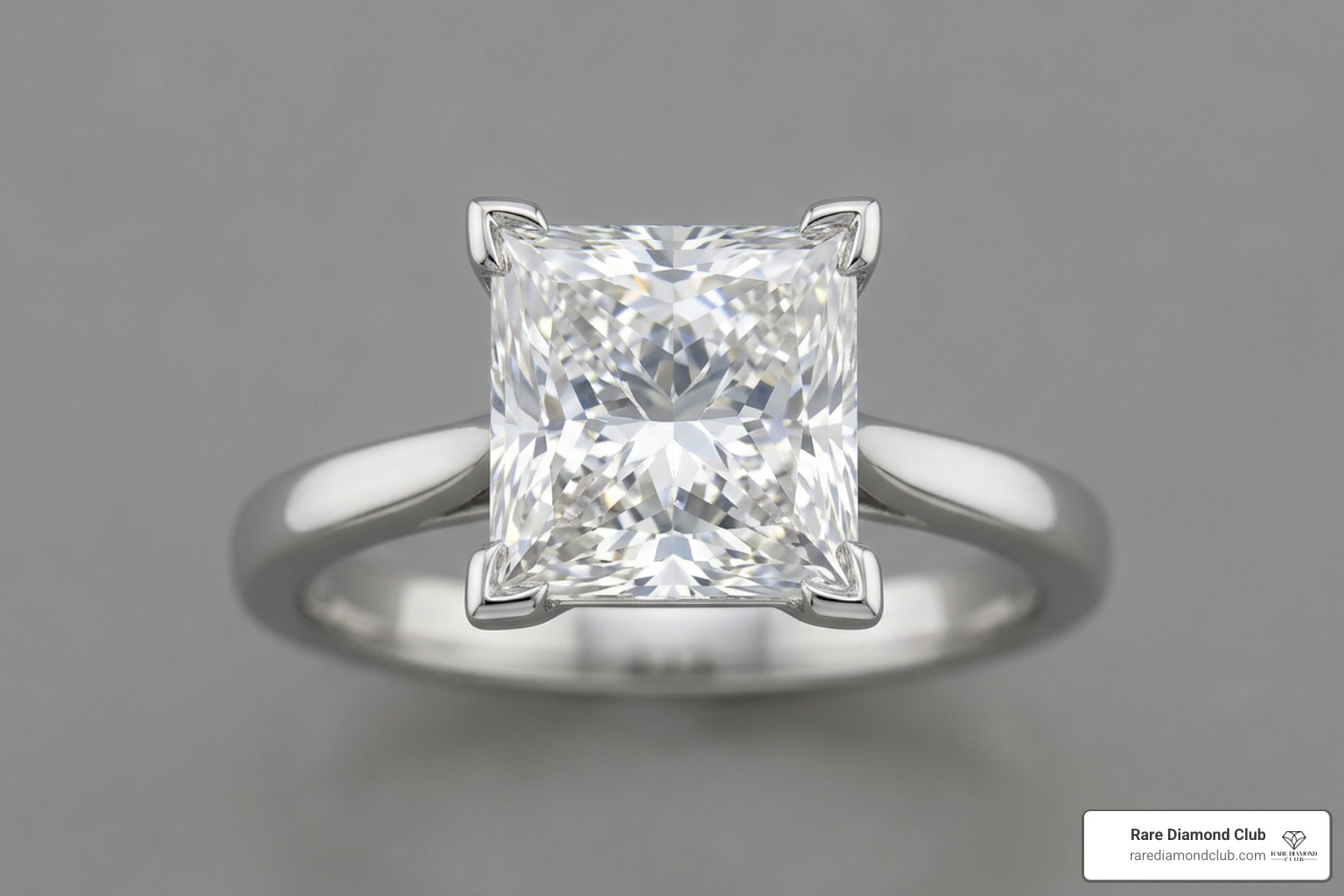
- V-Prong (Chevron) Settings: The 90-degree corners of princess cut diamonds are their most vulnerable structural points. V-shaped corner prongs wrap securely around these edges, shielding them from side impacts and preventing chipping.
- Cathedral Shanks: A cathedral setting uses graceful arches of metal that rise from the band to meet the diamond's basket. This provides enhanced structural support to the center head, preventing the ring from bending under pressure while giving the stone a regal, elevated posture.
- Hidden Halo Accents: For modern brides who want subtle brilliance, a hidden halo features a delicate circle of pavé-set diamonds wrapping just beneath the center stone's girdle. This enhances side-profile sparkle without distracting from the clean geometric lines of the primary square cut.
- Bezel and Semi-Bezel Mountings: A full or partial bezel wraps the diamond's perimeter in solid metal, offering the ultimate protection for active lifestyles while accentuating modern, clean lines.
Long-Term Care, Cleaning, and Corner Protection
Caring for a 2-carat diamond ring preserves its brilliance and structural integrity over decades of wear:
- Routine At-Home Cleaning: Soak the ring in warm water mixed with a few drops of mild dish soap for 15 minutes. Use an extra-soft toothbrush to gently remove lotion, oils, and debris from beneath the pavilion and behind the prongs. Rinse thoroughly with warm water and pat dry with a lint-free microfiber cloth.
- Avoid Harsh Chemicals: Never expose fine diamond jewelry to chlorine bleach, abrasive household cleaners, or harsh chemicals, which can erode precious metals like platinum and gold alloy solder joints.
- Bi-Annual Professional Inspections: Visit a bench jeweler every six months to verify prong tension. Because prongs can snag on fabrics, regular inspections ensure that the corner chevron prongs remain tight and flush against the diamond's surface.
Frequently Asked Questions About Square Diamond Engagement Rings
Do square diamonds look larger or smaller than round diamonds of the same carat weight?
Face-up surface area for a square diamond is slightly smaller than a round diamond of the identical carat weight because square stones carry more weight in their corners and pavilion depth. A 2-carat round brilliant measures roughly 8.1 mm in diameter, while a 2-carat princess cut measures around 7.0 mm across its edges. However, the corner-to-corner diagonal measurement of a 2-carat princess cut exceeds 9.0 mm, creating a distinctive optical illusion of expansive finger coverage.
Are princess cut diamonds prone to chipping?
The pointed corners of a princess cut represent localized stress points where the crystal lattice thins out. If struck hard against a granite countertop or metal door frame at an angle, unshielded corners can chip. However, this risk is mitigated entirely by choosing a quality mounting with protective V-prongs, bezel corners, or halo surrounds that encase these delicate points.
What is the price difference between natural and lab-grown square diamonds?
Lab-grown square diamonds are chemically identical to natural mined diamonds and certified by the same gemological laboratories (such as IGI and GIA). However, lab-grown diamonds generally cost 70% to 85% less than their natural counterparts of identical carat, color, cut, and clarity. This allows couples to choose higher color and clarity grades or larger carat weights within their designated proposal budget.
Conclusion
Choosing the ideal diamond for your proposal comes down to matching your personal aesthetic with lifestyle practicalities and budget. A 1-carat square stone offers understated grace, a 3-carat diamond makes an unapologetic statement, and a 2-carat square diamond ring hits that coveted balance of eye-catching presence, finger coverage, and everyday elegance.
At Rare Diamond Club, we exclusively specialize in fine diamond jewelry. We offer both natural and lab-grown diamonds, crafted into made-to-order engagement rings using the finest precious metals. Explore our complete bridal engagement ring collection to discover the ideal setting and diamond shape for your proposal.